
metalworkingmag.com
14
'26
Written on Modified on
Rethinking Chamfering for Machining Efficiency
Tungaloy advances modular chamfering tools to improve productivity, stability, and tool life in modern manufacturing environments.
tungaloy.com
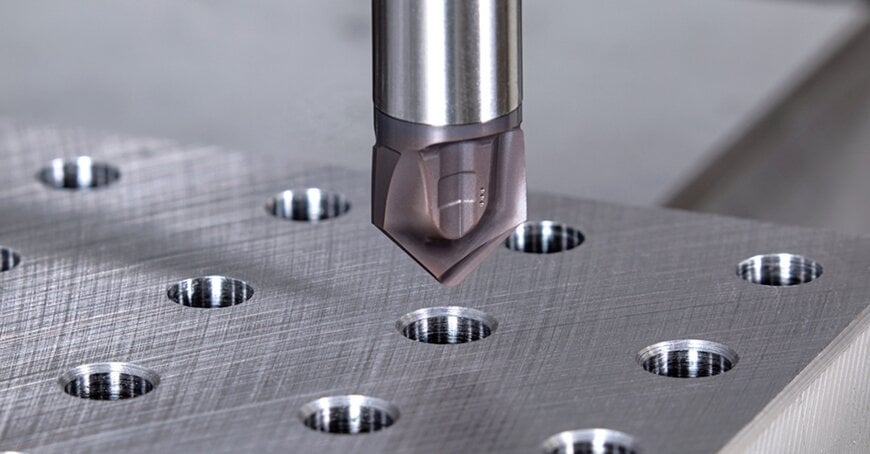
Chamfering, commonly treated as a secondary machining step, can significantly influence tool life, cycle time, and process stability in metalworking applications such as automotive, general engineering, and high-volume production lines.
Chamfering in the Context of Modern Manufacturing
Chamfering is typically positioned at the end of a machining sequence and is therefore often excluded from process optimization efforts. However, as manufacturing systems evolve toward higher efficiency and tighter tolerances—particularly within the digital supply chain—secondary operations increasingly affect overall productivity.
Even marginal improvements in chamfering can reduce rework, improve surface quality, and stabilize downstream processes such as assembly or coating.
Material Constraints and Cost Pressures
Historically, chamfering has relied on high-speed steel (HSS) tooling due to its relatively low cost and ease of use. This approach remains widespread in both standalone operations and automated production environments.
Recent shifts in material costs and production requirements are changing this balance. Rising prices for HSS and carbide raw materials, combined with increased demand for higher throughput, are exposing performance limitations in traditional tooling.
As a result, manufacturers are reassessing whether conventional tooling strategies meet current efficiency targets.
Performance Limitations in Conventional Chamfering
Attempts to increase productivity in chamfering often reveal recurring process limitations. These include burr formation requiring secondary finishing, chatter at elevated feed rates, and frequent tool replacement affecting machine uptime.
Such issues are typically linked to the mechanical and thermal constraints of HSS tooling. Compared with carbide, HSS exhibits lower hardness and wear resistance, limiting cutting speed and feed rate. This restricts the ability to scale performance without compromising stability.
Existing HSS Tool Configurations
HSS chamfering tools are commonly available in two configurations: solid tools and exchangeable head systems. Solid HSS tools offer simple construction and low initial cost but require full replacement or regrinding after wear. Exchangeable head variants allow reuse of the shank, reducing material waste, but retain the same fundamental limitations in cutting performance.
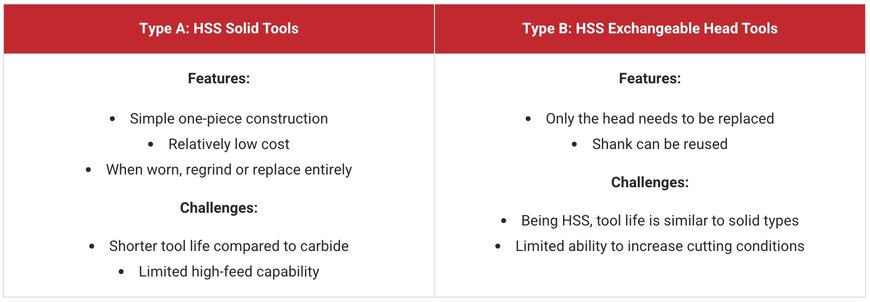
In both cases, tool life and achievable cutting conditions remain constrained by the material properties of HSS.
Modular Carbide Concept for Chamfering
An alternative approach focuses on optimizing material usage by applying carbide only where it is most effective—at the cutting interface. TungMeister applies this concept through a replaceable carbide head combined with a reusable shank.
This configuration improves wear resistance and cutting capability while reducing overall material consumption compared with fully solid carbide tools. The approach supports higher machining efficiency while maintaining cost control across production environments.
Application-Specific Chamfering Head Design
Different machining conditions require tailored tool geometries and cutting characteristics. General-purpose heads are designed for compatibility across a range of materials and are typically used in high-volume production environments such as automotive and general engineering.
Low cutting resistance designs reduce cutting forces and mitigate chatter, particularly in applications with long tool overhang or low-rigidity setups. These tools also support centering operations. High-efficiency variants incorporate multi-flute geometries, enabling higher feed per revolution and reducing cycle times in peripheral chamfering and deburring.
These configurations allow manufacturers to align tooling selection with specific process requirements, improving consistency and throughput.
Role of Tool Holding and System Rigidity
The performance of chamfering operations is also influenced by the selection of the tool shank. Long overhang conditions require higher rigidity, which can be achieved using carbide or tungsten shanks. In vibration-prone environments, materials with damping properties contribute to process stability. For applications requiring minimal overhang, integrated collet systems provide compact setups, while general-purpose machining may favor cost-efficient steel shanks.
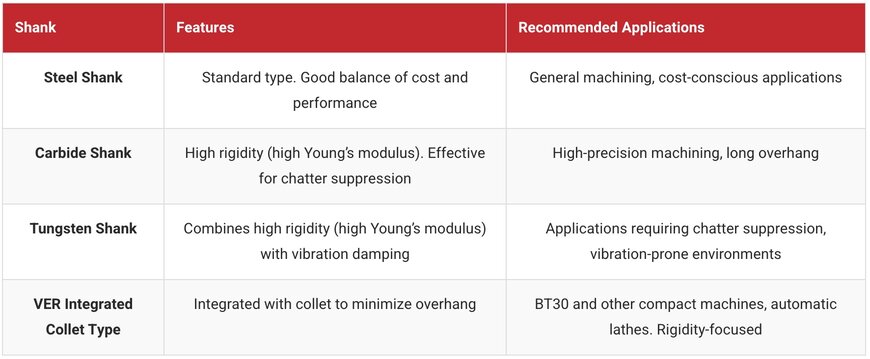
Selecting the appropriate combination of head and shank is therefore critical to maintaining stable cutting conditions and repeatable results.
Implications for Process Optimization
Re-evaluating chamfering as part of a broader machining strategy highlights its measurable impact on productivity and cost efficiency. By addressing tooling limitations and adopting modular solutions, manufacturers can reduce downtime, improve surface quality, and enhance process reliability.
As production environments continue to demand higher performance, secondary operations such as chamfering are increasingly relevant to achieving efficiency gains across the manufacturing value chain.
Edited by Romila DSilva, Induportals Editor, with AI assistance.
www.tungaloy.com
