
metalworkingmag.com
02
'26
Written on Modified on
Precision machining strategies for automotive aluminum steering knuckles
MAPAL develops specialized tooling strategies to address the complex tolerances and material challenges associated with integrated forged aluminum chassis components.
mapal.com
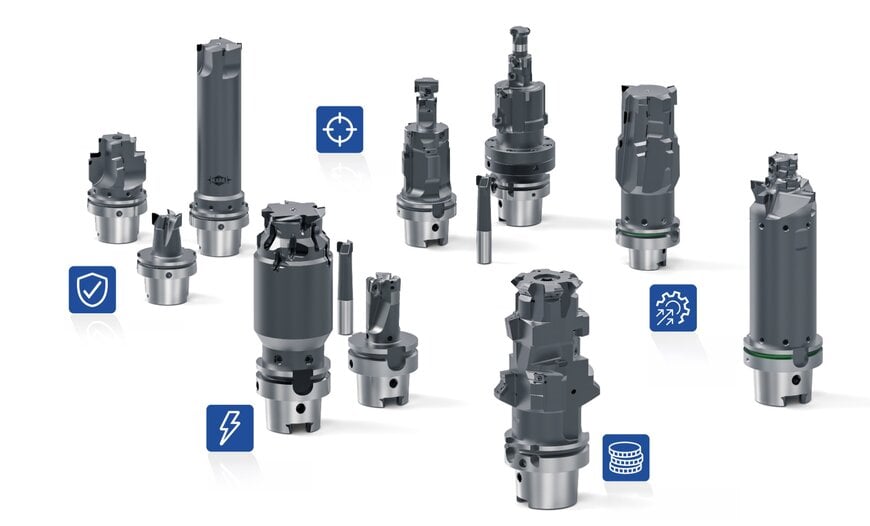
MAPAL introduces a series of polycrystalline diamond (PCD) and indexable cutting tools designed for the high-volume production of wheel carriers and steering knuckles. These machining solutions target the automotive supply chain, specifically addressing the transition toward lightweight, highly integrated aluminum functional modules in passenger vehicles.
Material transitions in automotive chassis manufacturing
Wheel carriers and steering knuckles have evolved from passive structural parts into complex functional modules that incorporate mounting points for brake calipers, wheel hubs, anti-lock braking systems (ABS), and autonomous driving sensors. To meet strict efficiency and lightweight construction standards driven by electromobility, automotive manufacturers are shifting from cast iron and die-cast aluminum to forged aluminum. Forged aluminum withstands higher mechanical loads but features a lower silicon content. This material composition complicates chip breaking during machining and increases the likelihood of material adhering to the cutting edges.
Tooling mechanisms for main bearing bore accuracy
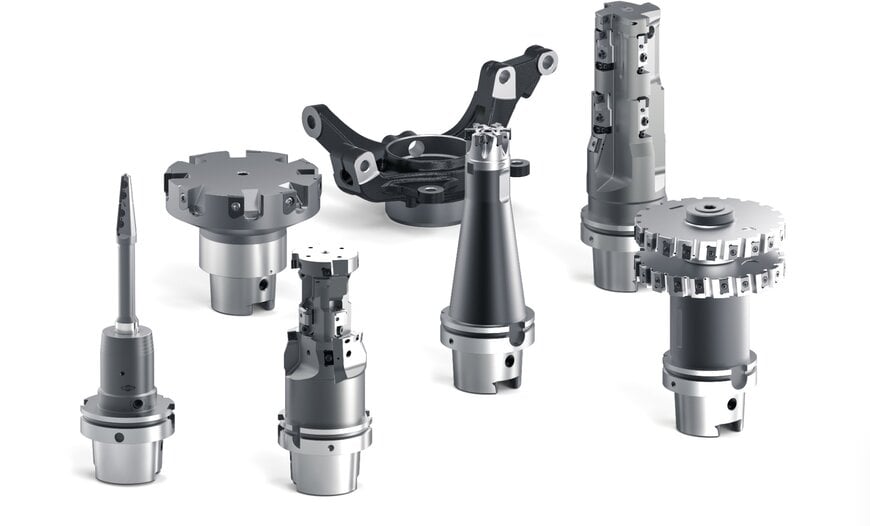
The main bearing bore requires significant material removal, often starting from a pre-punched or roughly cast contour. To achieve the required IT6 tolerance levels, the preliminary machining phase utilizes PCD circular milling and drilling tools. The OptiMill-Diamond-SPM milling cutter relies on a highly positive cutting geometry and optimized chip spaces to reduce cutting forces by up to 15 percent compared to conventional PCD milling tools. For finishing operations, precision boring tools utilize the EasyAdjust system. This mechanism integrates the secondary cutting edge taper directly into the holding cassette, allowing operators to make micrometer-level diameter adjustments without needing to recalibrate the taper.
Managing tool deflection and thermal deformation
The control arm connection serves as the primary mechanical interface between the steering knuckle and the chassis. Machining these interfaces often requires tools with overhang lengths reaching 300 millimeters. At this length, the spindle approach can generate a tilting moment, causing tool deflection that compromises dimensional accuracy. Furthermore, high feed rates and helical plunging generate substantial heat, which, when combined with minimum quantity lubrication (MQL), can cause thermal deformation of the component. To counter these physical forces, specialized PCD ball-nose cutters feature a specifically calculated cutting edge arrangement that neutralizes intentional tool vibration during angled bolt-hole boring.
Integration into automated production environments
To maintain positional accuracy and eliminate errors caused by part transfer, steering knuckles are primarily machined in a single clamping operation on multi-spindle computer numerical control (CNC) machines. By deploying a turnkey approach that includes process design, customized clamping fixtures, and tailored tool geometries, these systems can sustain production volumes exceeding 500,000 units annually while maintaining strict form and surface quality requirements.
Additional Context
This section details technical specifications and competitive benchmarking not included in the original news release.
Within the high-volume automotive machining sector, tooling for forged aluminum steering knuckles competes directly with PCD and indexable milling systems from manufacturers such as Sandvik Coromant and Walter Tools. Benchmarking in this domain typically focuses on metal removal rates (MRR), tool life, and the ability to maintain IT6 or tighter tolerances over extended, continuous production runs. While Sandvik’s CoroMill Century series utilizes lightweight aluminum bodies with high-speed inserts to minimize centrifugal forces at high rotational speeds, MAPAL’s architecture emphasizes the EasyAdjust cassette mechanism to reduce machine downtime during precision finishing setups. The broader industry transition to forged aluminum with low silicon content forces all major tooling manufacturers to prioritize specialized PCD grades and highly positive rake angles to prevent built-up edge (BUE) formation, which remains the primary cause of surface finish degradation in automated chassis machining.
Edited by Aishwarya Mambet, Induportals Editor, with AI assistance.
www.mapal.com
