
metalworkingmag.com
21
'26
Written on Modified on
OPEN MIND hyperMILL advances AS9100-compliant aerospace manufacturing
The CAD/CAM suite leverages NC code-based simulation and high-performance cutting to optimize the machining of complex aerospace components.
www.openmind-tech.com
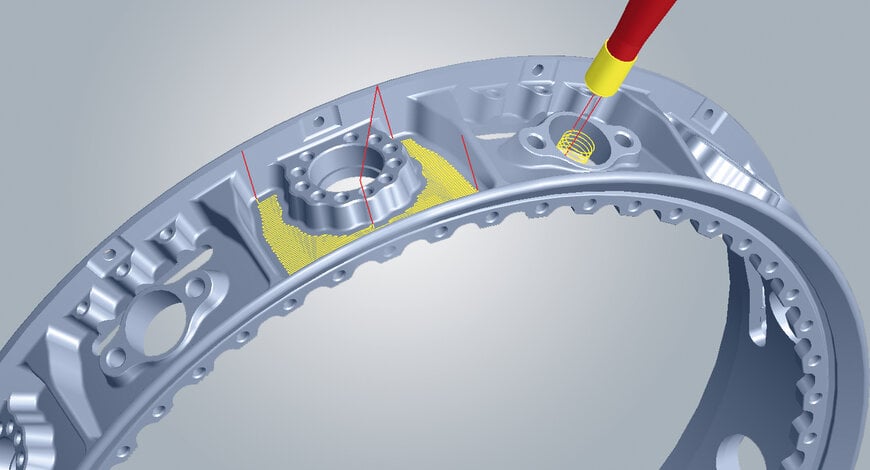
A growing number of aerospace manufacturers are adopting OPEN MIND’s hyperMILL CAD/CAM suite to support production processes compliant with rigorous AS9100 and EN9100 quality management standards. Engineered to machine lightweight yet highly robust components, the software is being deployed across a wide spectrum of aerospace applications, including engine and landing gear components, eVTOL structures, and rocket components such as thrust frames and fuel tanks. To handle these highly complex geometries and stringent dimensional tolerances, the platform provides advanced 5-axis technologies, specialized modules for blisks and impellers, and sophisticated turning and milling strategies.
Virtual machining and collision avoidance
In high-value aerospace manufacturing, preventing machine crashes and workpiece gouging is critical. To ensure process reliability, the suite utilizes hyperMILL VIRTUAL Machining, which provides highly accurate machining simulation. Denton Lewis, CAM Manager at aerospace contract manufacturer Western Precision Products, noted that the simulation's ability to perfectly match physical reality allows operators to know exactly what to expect on the machine, preventing costly errors.
High-performance cutting for challenging materials
The aerospace sector heavily relies on difficult-to-machine materials such as titanium, Inconel, superalloys, and fiber-reinforced composites. To manage large chip volumes and minimize tool wear, the hyperMILL MAXX Machining module utilizes optimized High-Performance Cutting (HPC) strategies. In a recent production case, Shreeram Aerospace & Defence utilized the software to manufacture aluminum antenna reflector panels, machining a 150 kg raw blank down to a 10.5 kg finished component featuring thin pocket walls measuring just two millimeters. According to Sandeep Satani, Chairman and Managing Director of the firm, the hyperMILL strategies successfully reduced roughing time from 40 to 30 hours while simultaneously improving surface quality from Ra 0.8 µm to Ra 0.4 µm.
Additional Context: NC code-based simulation vs. Internal CAM simulation
This section details technical specifications and competitive benchmarking not included in the original product announcement.
In standard CAD/CAM workflows, traditional toolpath simulation occurs before the post-processor translates the data into the specific machine's language. This internal CAM simulation calculates the theoretical tool movements but remains blind to potential errors introduced during post-processing, such as specific CNC controller behaviors, unique machine kinematics, or rotary axis singularity limits. For 5-axis simultaneous aerospace machining, this gap can lead to catastrophic machine collisions or the scrapping of extremely expensive titanium billets. The hyperMILL VIRTUAL Machining module solves this by utilizing true NC code-based simulation. It simulates the exact G-code generated after the post-processor phase—the identical code the physical CNC machine will execute. By networking with the machine controller to create a highly accurate digital twin of the specific machine tool, it guarantees absolute collision detection and allows for the automatic optimization of toolpaths to keep axes within their physical travel limits.
Edited by an industrial journalist, Lekshman Ramdas, with AI assistance.
www.openmind-tech.com
