
metalworkingmag.com
22
'26
Written on Modified on
HORKOS and Meltio introduce NX70 DUO hybrid manufacturing system
The twin-head machining center integrates Wire-DED and precision subtractive cutting to streamline the production and repair of complex metal parts.
www.meltio3d.com
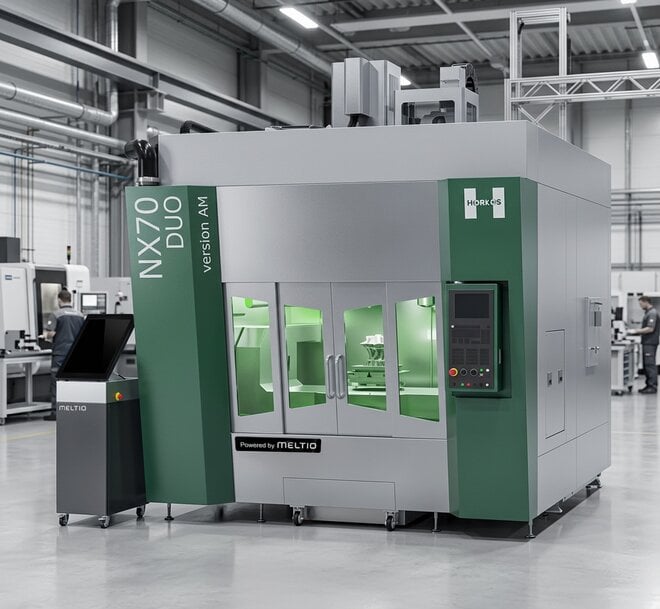
HORKOS CORP and Meltio have launched the NX70 DUO version AM, a twin-head hybrid manufacturing center that combines metal additive manufacturing with high-precision CNC cutting. Based on the HORKOS NX70 1510B platform and debuting at the JIMTOF 2026 trade fair in Tokyo, the system allows operators to alternate between laser-based material deposition and precision subtractive machining within the exact same setup. The first unit has already been acquired by a major international industrial customer.
Wire-DED and Bedless architecture
The integrated Meltio deposition head utilizes standard welding wire feedstock and laser energy to build or repair metal components. This Wire Directed Energy Deposition (Wire-DED) technology eliminates the hazardous handling requirements and dedicated facility isolation associated with reactive metal powders. To optimize the physical footprint, the machine utilizes HORKOS's proprietary "Non Bed Structure" (Bedless design), which positions structural components away from the immediate machining area to prevent thermal displacement caused by hot chips and coolant. Furthermore, the system incorporates the company's water-soluble iMQL (Minimum Quantity Lubricant) technology to deliver an environmentally cleaner, highly efficient machining environment.
Hybrid applications and market expansion
By consolidating multiple manufacturing stages into a single machine, the NX70 DUO version AM drastically reduces the need to transfer components between different systems, directly mitigating floor-space constraints and severe labor shortages. The ability to alternate between deposition and milling is particularly critical for manufacturing complex internal geometries, such as closed impellers, where conventional tooling access is physically restricted. Supported by MadeHere, Meltio’s official partner in Japan, the platform targets aerospace, defense, energy, and heavy industry applications. This aligns with a growing global trend in hybrid manufacturing, highlighted by the recent acquisition of 12 Meltio-integrated CNC hybrid systems by the U.S. Navy for point-of-need fleet sustainment and repair.
Additional Context: Bedless CNC structures and thermal displacement
This section details technical specifications and competitive benchmarking not included in the original product announcement.
In traditional machining centers, the massive cast-iron "bed" sits directly underneath the spindle and workpiece to provide structural rigidity. However, this design inherently catches hot metal chips and coolant fluid during heavy cutting operations. The continuous transfer of heat from these chips into the cast-iron bed causes thermal expansion and minute geometrical distortions (thermal displacement) across the machine's axes, progressively degrading machining accuracy over long production runs. HORKOS's "Bedless" (Non Bed Structure) architecture resolves this by suspending the workpiece and locating the slide mechanisms on robust vertical columns, leaving the space directly beneath the cutting zone completely empty. This allows hot chips and coolant to fall straight through into an evacuation conveyor without ever transferring heat to the machine's structural core, guaranteeing high-precision dimensional stability during extended hybrid manufacturing cycles.
Edited by an industrial journalist, Lekshman Ramdas, with AI assistance.
www.meltio3d.com
