
metalworkingmag.com
29
'26
Written on Modified on
MTC Expands Large-Format Metal Additive Capabilities with Caracol Vipra XP AM
The UK's Manufacturing Technology Centre integrates Caracol's robotic DED-Arc platform to accelerate qualification and industrial scaling of large-scale metal components.
www.caracol-am.com
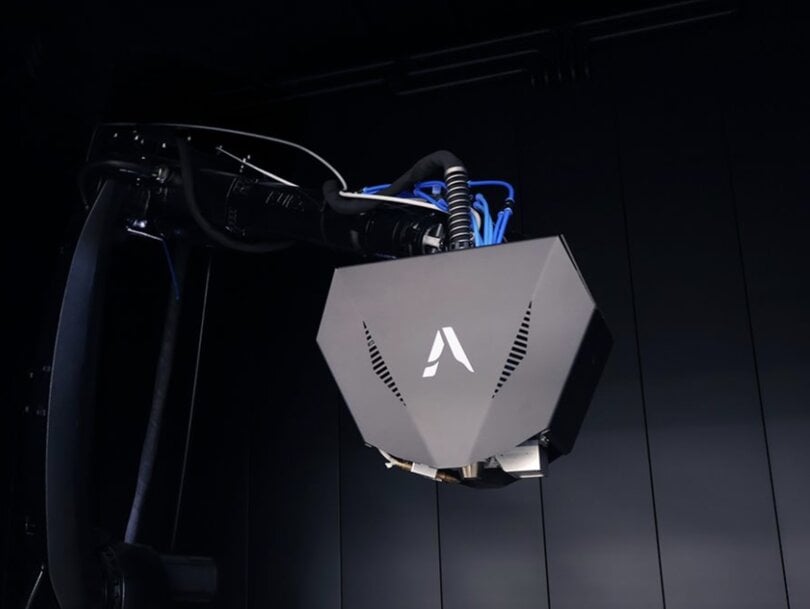
Heavy-industry sectors such as aerospace, defence, energy, and rail face escalating lead times and material waste when procuring large-scale structural metal components through traditional subtractive machining and casting routes. Forgings and sand castings for oversized structural parts often require months of supply-chain queue times, tie up capital in specialized tooling dies, and yield high buy-to-fly ratios where the majority of raw material is machined away as scrap. While metal additive manufacturing offers geometric freedom and reduced lead times, conventional laser powder bed fusion platforms remain constrained by rigid chamber volumes, slow build rates, and prohibitive raw-material powder costs. Resolving these fabrication bottlenecks requires large-format robotic directed energy deposition systems capable of depositing wire alloys at high build rates while maintaining closed-loop process control and metallurgical integrity across complex multi-axis envelopes.
Robotic DED-Arc Integration at NCAM
To advance the industrial readiness of large-scale additive manufacturing, the Manufacturing Technology Centre (MTC)—a prominent UK independent research and technology organization and part of the High Value Manufacturing Catapult network established with Innovate UK—has selected the Vipra XP AM system from Caracol. Installed within the National Centre for Additive Manufacturing (NCAM), the robotic arc-based directed energy deposition (DED-Arc) platform significantly expands the center's capacity to research, develop, and qualify large-format metal applications across global aerospace, defence, automotive, rail, construction, and energy supply chains.
The Vipra XP AM platform utilizes multi-axis articulated robotics to deposit a wide range of structural metal alloys without the build envelope restrictions imposed by enclosed powder-bed printers. Supported by Caracol’s proprietary Eidos Manufacturing software suite, the installation provides the MTC engineering team with unified, end-to-end digital control spanning toolpath slicing, multi-axis kinematic trajectory generation, dynamic parameter adaptation, real-time in-process sensing, and post-build data visualization required for strict industrial qualification standards.
Collaborative Qualification and Scaled Industrial Deployments
The collaboration builds on active development initiatives between MTC and Caracol targeting high-complexity industrial components where standard metal manufacturing methods fail to deliver the required geometric flexibility, weight optimization, or mechanical properties at scale.
As Caracol transitions from early-stage technology development to qualified production deployments across critical sectors, partnering with MTC provides direct access to Catapult-level metallurgical evaluation, non-destructive testing suites, and a shared testing ground connecting research academia to multinational manufacturing primes.
Additional Context
This section details technical specifications and competitive benchmarking not included in the original product announcement.
In large-format additive manufacturing governed by standards such as ISO/ASTM 52942 (governing wire-arc additive manufacturing / DED-Arc), robotic wire-arc deposition relies on gas metal arc welding (GMAW), cold metal transfer (CMT), or plasma arc sources to melt standard welding wire feedstocks along robotic toolpaths. Deposition rates in multi-axis DED-Arc systems typically range from 2 to 10 kilograms per hour depending on alloy selection—processing structural materials such as titanium alloys (Ti-6Al-4V), nickel-based superalloys (Inconel 625 and 718), duplex stainless steels, and high-strength aluminum grades at a fraction of the cost of atomized gas powders. Achieving aerospace-grade fatigue strength and grain structure demands continuous closed-loop pyrometric monitoring to control interpass temperatures and heat input, preventing localized thermal accumulation, residual stress deformation, and porosity defects across tall, thin-walled geometries.
Within the large-scale metal additive landscape, Caracol’s Vipra XP platform benchmarks against dedicated wire-arc robotic and gantry systems from MX3D (M1 Metal AM System), WAAM3D (RoboWAAM and MiniWAAM), Sciaky (EBAM electron beam directed deposition), and Gefertec (3DMP arc machines). While conventional systems often pair third-party welding power sources with standard industrial robot controllers using separate computer-aided manufacturing plug-ins—resulting in fragmented toolpath simulation and collision risk—Caracol’s integration of Eidos Manufacturing unifies slicing algorithms with real-time robotic kinematic reachability and welding parameter control. This integrated software-hardware architecture allows the MTC to simulate deposition strategies, optimize bead overlap geometry, and generate auditable digital material twins for aerospace and defence primes seeking formal airworthiness or defense qualification.
Edited by Romila DSilva, Induportals Editor, with AI assistance.
www.caracol-am.com
