
Deep-Hole Drilling Tools with Additively Manufactured Internal Coolant Channels
Tungaloy introduces Fine-BeamJet exchangeable BTA drill heads featuring curved, 3D-printed internal coolant channels to optimize chip evacuation and rigidity.
tungaloy.com
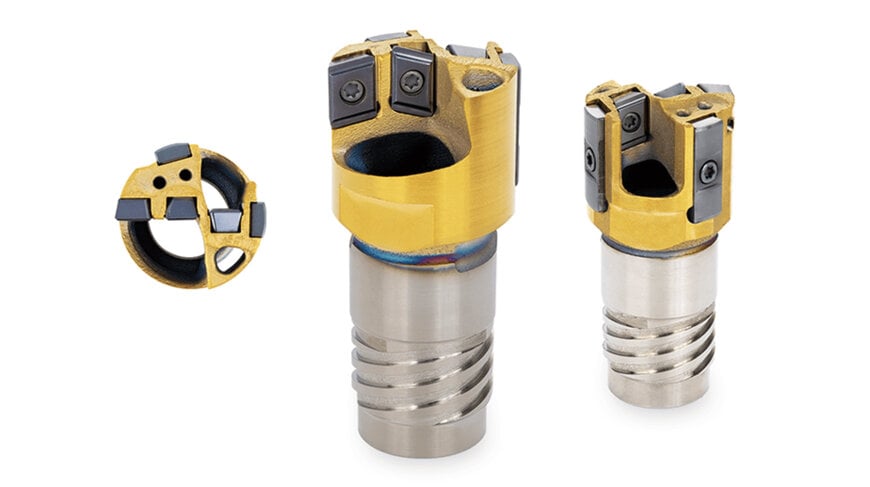
Boring and Trepanning Association deep-hole drilling operations require sustained fluid pressure and volume to manage thermal loads, stabilize cutting dynamics, and prevent catastrophic chip packing in high-aspect-ratio holes. In response to the flow and structural limits of conventional tooling, cutting tool manufacturer Tungaloy Corporation has developed the Fine-BeamJet series of exchangeable BTA drill heads. Produced via additive manufacturing, the tooling series introduces non-linear, custom-profile coolant passages designed to deliver higher hydraulic delivery to the cutting zone across mid-diameter drilling operations.
Hydraulic and Structural Constraints in Conventional BTA Tooling
Deep-hole drilling across automotive drive shafts, heat exchanger tube sheets, and heavy industrial components relies on precise thermal control and rapid fluid evacuation. In standard BTA machining, high-pressure cutting fluid is pumped through the annular clearance between the machined bore wall and the external diameter of the drill tube. The fluid reaches the cutting zone, cools the cutting edges and guide pads, and pushes chips backward through the hollow interior of the drill head and boring bar.
In conventional subtractive manufacturing, internal coolant channels must be produced via mechanical gun drilling, which restricts passages to straight, uniform circular geometries. In medium diameter ranges—particularly around 30 mm—drilling generates high thermal loads and large chip volumes. However, machining internal channels into a steel body of this size forces an engineering trade-off: enlarging straight bores to supply adequate coolant cross-sectional area removes essential core material, compromising the structural rigidity needed to resist torsional deflection and guide pad chatter.
Additive Manufacturing Architecture and Flow Path Optimization
Fine-BeamJet resolves these mechanical constraints by employing additive manufacturing to form the drill body. Laser powder bed fusion or equivalent metal additive techniques eliminate the geometric limitations of straight-hole subtractive boring, allowing engineers to design curved fluid conduits and irregular channel cross-sections directly within the core geometry.
By placing contoured channels along stress-neutral axes of the drill head, the design increases hydraulic fluid volume and flow velocity directly toward the cutting zone without subtracting core material from critical load-bearing cross-sections. This continuous, optimized fluid delivery enhances chip curling, controls cutting temperature, and forces chips continuously through the internal evacuation bore, preventing chip packing. In addition, the additive material process yields a higher surface and core hardness, mitigating elastic deformation under radial loads and prolonging the service life of both the tool body and the integrated guide pads.
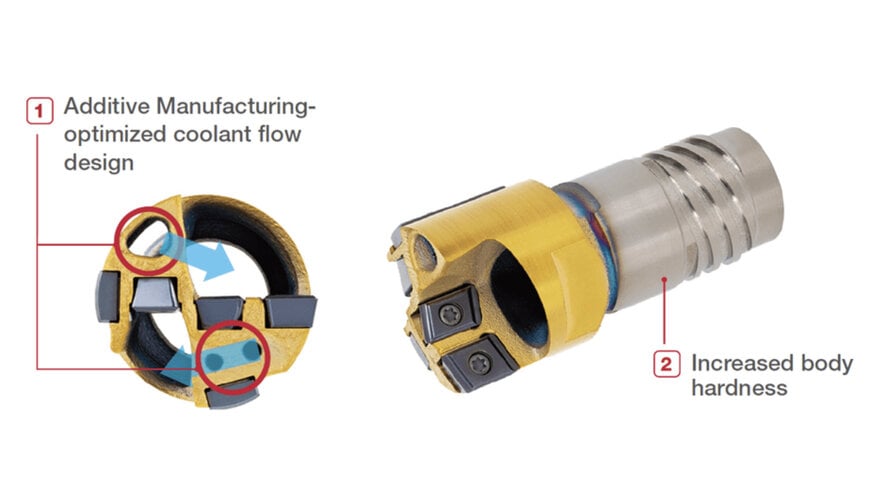
Tool Specifications and Supply System Compatibility
The Fine-BeamJet product line targets hole diameters from 25 mm to 33 mm, covering the critical transition range where internal clearance is heavily constrained. To support varied machine tool configurations, the exchangeable heads are engineered for two primary industrial fluid delivery architectures:
- Single Tube System: External high-pressure fluid enters the drilling zone via the outer annular gap, evacuating coolant and swarf through the central bore of a single hollow drill tube.
- Double Tube System: Fluid is fed down the concentric annular space between inner and outer tubes, then evacuated with chips through the inner tube, eliminating the requirement for an external high-pressure seal against the workpiece face.
Both configurations integrate exchangeable cutting inserts and wear pads, allowing operators to maintain bore tolerance and surface finish repeatability without removing the boring bar from the machine spindle.
Additional Context:
This section details technical specifications and competitive benchmarking not included in the original product announcement.
In deep-hole drilling, the BTA method operates under ISO 3000 series standards for deep-hole drilling equipment, where length-to-diameter ratios frequently exceed 10:1 and reach up to 100:1. The thermal and hydraulic performance of BTA drill heads directly governs the limits of allowable feed rates and cutting speeds (vc), typically ranging from 80 to 140 m/min in standard alloy steels when utilizing coated carbide inserts.
Conventionally machined BTA drill heads from manufacturers such as Sandvik Coromant, Botek, and Guhring historically rely on brazed or mechanically fastened bodies with straight, round fluid holes drilled via multi-axis CNC or auxiliary gun-drilling cycles. These straight-line geometries suffer fluid turbulence and pressure drops at directional junctions, requiring system pressure ratings often exceeding 40 to 70 bar to maintain adequate volumetric throughput. Additively manufactured conformal passages reduce pressure losses by smoothing internal bend radii and matching hydraulic area to local flow requirements. In addition, metal additive manufacturing with tool steels such as 1.2709 (maraging steel) achieves post-treatment hardness values exceeding 50 to 54 HRC, outperforming standard low-alloy structural steels often used in complex welded or assembled cutter bodies, thereby offering greater resistance against bore deflection and abrasive guide-pad seat wear.
Edited by Natania Lyngdoh, Induportals editor, with AI assistance.
www.tungaloy.com
