
metalworkingmag.com
18
'25
Written on Modified on
Toolpath-Aware Simulation for FDM Parts
Stratasys integrates Novineer’s polymer performance simulation into GrabCAD Print Pro to enable predictive validation of load-bearing FDM components.
www.stratasys.com
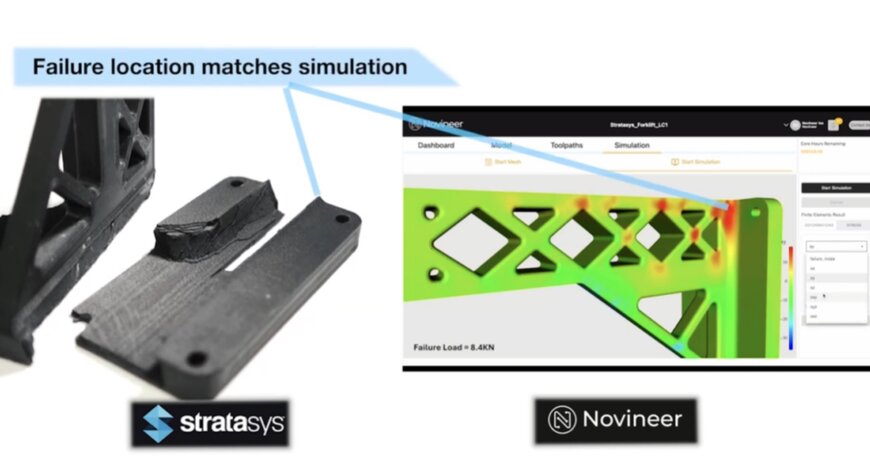
Stratasys has partnered with Novineer to integrate toolpath-aware polymer performance simulation into GrabCAD Print Pro, enabling engineers to predict the mechanical behaviour of FDM parts before printing and reduce reliance on physical testing.
Bridging design intent and printed part behaviour
In material extrusion additive manufacturing, part performance is strongly influenced by build orientation, layer direction, infill strategy, and toolpath decisions. Conventional finite element analysis tools typically model printed parts as homogeneous solids, which limits their ability to accurately predict stiffness, strength, and failure in real-world applications.
The integration of Novineer’s NoviPath simulation with GrabCAD Print Pro addresses this gap by using actual GrabCAD toolpath data as the basis for simulation. By incorporating process-specific parameters, the solution enables more realistic modeling of how FDM parts behave under load, particularly in safety-critical and load-bearing applications.
Process-aware simulation using GrabCAD data
NoviPath uses build data generated during print preparation to simulate part performance under defined load cases and safety factors. Engineers can assess stiffness, strength, and likely failure locations without exporting data to external tools or simplifying assumptions about material behaviour.
Early users report that the increased accuracy enables weight reductions of up to 35% in load-bearing parts while maintaining required performance margins. Such reductions are typically achieved by avoiding conservative overdesign that compensates for uncertainty in part behaviour.
Reducing iteration and validation cycles
Physical testing of FDM parts can require multiple design-print-test iterations, extending development timelines and increasing cost. By enabling virtual iteration based on toolpath-aware simulation, the integrated workflow allows engineers to converge on validated designs before printing.
According to Stratasys, this approach can reduce validation cycles from weeks to hours, particularly for industrial applications where certification or internal qualification processes require predictable and repeatable performance.
Platform support and material validation
The initial integration is planned to support Stratasys FDM systems, including the F3300, F900, and Fortus 450mc platforms, with additional systems to follow. A validated material library will be included, starting with Antero 800NA, FDM Nylon 12CF, and ULTEM 9085 filaments, with further materials to be added over time.
Material validation is a critical aspect of simulation accuracy, as polymer properties in extrusion-based printing are anisotropic and process-dependent. Validated datasets help align simulated results with printed part behaviour.
Implications for industrial additive manufacturing
By embedding performance simulation directly into print preparation software, the integration extends Stratasys’ software ecosystem across the full engineering workflow—from design and slicing to performance validation and production. This supports broader adoption of FDM for end-use and structurally loaded parts, where predictable performance is a prerequisite.
Within the context of industrial additive manufacturing, toolpath-aware simulation represents a shift toward more data-driven qualification of printed parts. As production volumes and application criticality increase, such integrated workflows are becoming central to reducing risk, cost, and time-to-production.
www.stratasys.com
