
Hurco Europe Highlights Automation and 5-Axis Machining at MACH 2026
Hurco Europe will present CNC automation cells, enhanced 5-axis machining centres and advanced control software for high-mix production.
www.hurco.com
Targeting subcontract machining, aerospace, precision engineering and toolmaking sectors, Hurco Europe will use MACH 2026 (NEC Birmingham, 20–24 April 2026, Stand 19-140) to demonstrate intelligent CNC control, integrated robot automation and high-precision 5-axis machining solutions designed to shorten lead-times and support high-mix, low-volume manufacturing.
How CNC Automation Supports High-Mix, Low-Volume Production
Subcontract manufacturers frequently manage short production runs where each new job requires rapid setup and programming. Reducing programming time while maintaining flexibility is therefore central to profitability.
Hurco Europe’s theme, “Smarter CNC for Smarter Shops,” reflects a strategy built around intuitive machine control and automation that reduces reliance on dedicated CNC programmers. According to managing director David Waghorn, rapid progression from concept to finished component is critical when every order differs in geometry and batch size.
This approach combines conversational programming with conventional NC workflows, allowing operators to adapt quickly without abandoning established CAM processes.
WinMax Control: Bridging Conversational and G-Code Programming
At the core of the presentation is Hurco’s proprietary WinMax CNC control. The system allows merging of conversational programming and G-code within the same job, enabling CAM-generated 3D surfaces to be integrated into conversational programs, or conversational cycles to be inserted into NC code.
This hybrid capability is relevant in toolrooms and subcontract environments where complex geometries coexist with simpler features such as pockets, holes and contours. Solid model import further reduces programming time by allowing direct use of CAD data.
An additional productivity feature is the Interrupt Cycle function. During machining, the operator can jog the tool away to inspect inserts or cutting edges. A single command returns the tool precisely to its original position in the cycle. This capability supports process reliability without requiring program restarts, which can otherwise increase scrap risk or downtime.
In the context of CNC automation, these software functions aim to shorten setup time and maintain flexibility across varying part geometries.
First Machine Tending Cell Based on a 6-Axis Industrial Robot
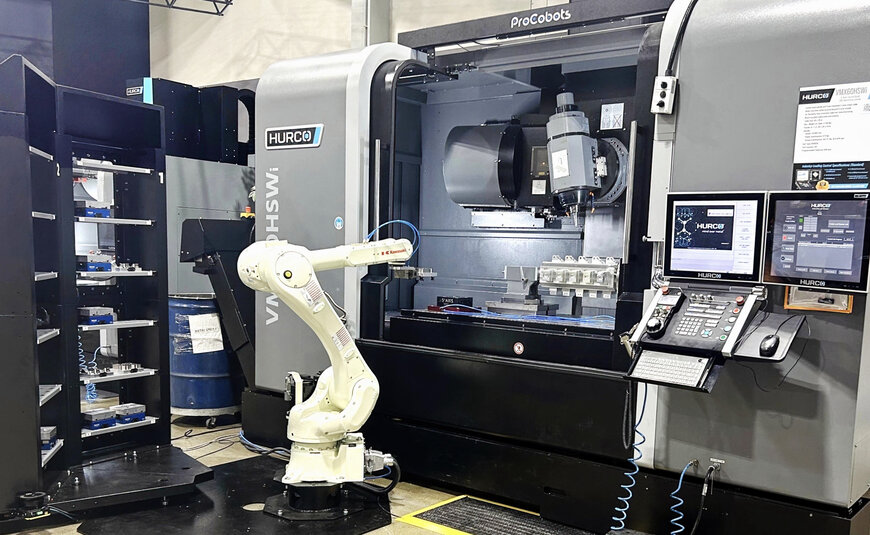
Hurco Europe will present its first standardised machine tending cell built around a 6-axis industrial robot. The system combines a 5-axis VC500i machining centre with a Kawasaki PC 25 robot, forming an integrated automation package.
The robot can handle pallets, fixtures and components weighing up to 25 kg, supplied from a heavy-duty rack system. Unlike collaborative robots typically used for lighter-duty tending, the industrial robot configuration increases load capacity, making it suitable for both longer production runs and small-batch automation.
Programming is carried out via the same Hurco control interface used for cobot solutions. The company states that operator training to achieve proficiency requires less than one day, which may be significant for workshops without dedicated robotics specialists.
The cell results from a strategic collaboration between Kawasaki Robotics and Hurco announced at IMTS 2024.
Expanded 5-Axis Range for Automated Production
Three 5-axis machines will be demonstrated:
A new 60-station version of the VMX42SRTi increases tool capacity, enhancing suitability for automated production where tool changes must support unattended machining. The machine features torque motor direct drives on the B and C axes, a 600 mm diameter rotary table and 2,000 kg rotary capacity, while maintaining the footprint of a standard 3-axis, 1-metre travel machine.
The VC500i, shown within the automated cell, features a cantilever design suited to multi-face machining in a single setup.
Completing the 5-axis line-up is the VMX30Ui, equipped with a 12,000 rpm spindle, 15 kW spindle power and torque delivery of 214 Nm, positioning it for precision components requiring balanced speed and torque performance.
Compared with other mid-size 5-axis machining centres offering similar spindle speeds and rotary capacities, the main differentiator lies in the integration of conversational and G-code programming within the control environment rather than purely in spindle specifications.
3-Axis and Turning Solutions with Integrated Automation
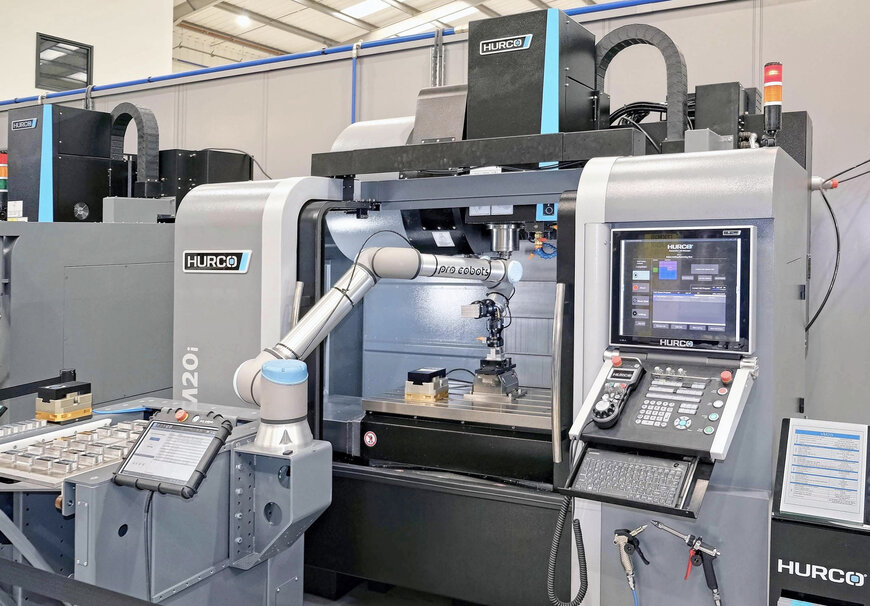
The 3-axis vertical machining centre range includes a VM10i and a VM20i equipped with a ProCobot Profeeder-X 10-drawer automation system. This drawer-based configuration supports flexible batch changes without complex pallet systems, making it suitable for subcontract environments.
CNC turning solutions on display include driven-tool models TM8Mi and TMX8MYSi. The latter incorporates Y-axis turret motion and a sub-spindle, enabling complete machining of complex parts in a single setup, reducing secondary operations and alignment variability.
High-Speed, High-Precision Machining with Roeders
Under a long-standing agency agreement, Hurco Europe will also exhibit for the first time in the UK the Roeders RPT450DS EcoSpray.
This 5-axis machining centre is designed for milling, jig grinding and in-process measurement. The “DS” designation refers to dual support of the swivelling rotary table, increasing structural stability during simultaneous 5-axis machining.
The EcoSpray system integrates patented tool cleaning and minimum quantity lubrication, reducing coolant usage while maintaining tool condition.
The RPT series introduces Precitemp technology aimed at improving thermal stability. The manufacturer indicates that achievable tolerances are reduced from conventional micron-level precision toward sub-micron and nanometre ranges, even under variable ambient temperature conditions. In high-precision mould, die and micro-machining sectors, such thermal compensation strategies are critical to maintaining dimensional stability.
www.hurco.com
