
metalworkingmag.com
02
'26
Written on Modified on
Automated CNC Programming and Multi-Axis Toolpath Optimization in Manufacturing
Hexagon has introduced updated Computer-Aided Manufacturing (CAM) capabilities to enhance CNC programming automation, process predictability, and multi-channel machine synchronization for complex industrial environments.
hexagon.com
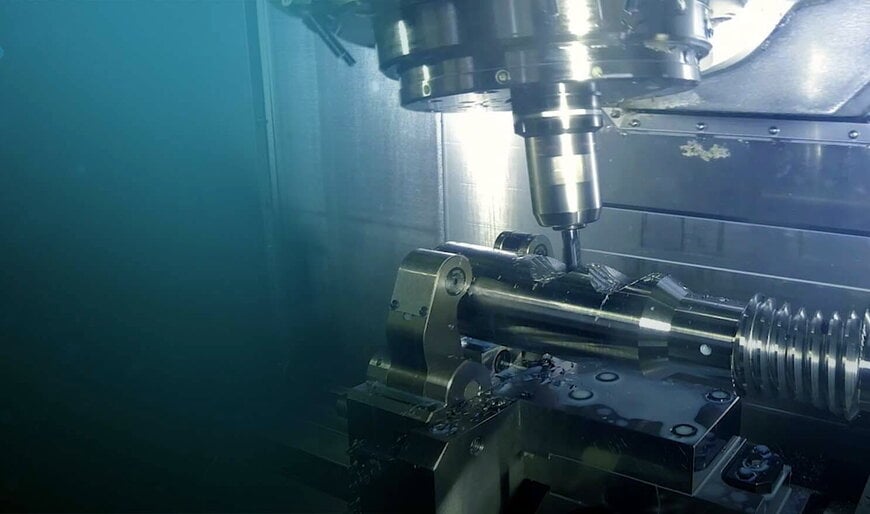
As CNC machine architectures advance toward higher degrees of freedom and multi-channel synchronization, the computational effort required for program verification and toolpath generation increases. The initial 2026 update for ESPRIT EDGE addresses these complexities by integrating AI-assisted process definition and expanded kinematic support. These developments target the automotive data ecosystem and aerospace sectors, where high-precision tolerances and frequent design iterations require agile manufacturing workflows.
Automation in Turning and Swiss-Type Machining
The integration of ProPlanAI for turning, mill-turn, and Swiss-style programming facilitates automated process sequencing. This mechanism analyzes stock removal rates and historical machining strategies to define toolpaths, reducing the manual input required for complex part geometries. By utilizing data-driven process definitions, the system minimizes the requirement for physical test cuts on the shop floor.
For Swiss sliding-headstock operations, the software now includes native support for multiple guide bushing configurations within the machine models. This allows for transitions between chucker-mode and standard configurations without the need to reconstruct machine definitions. This kinematic flexibility is critical for shops managing diverse production runs on the same hardware.
Toolpath Reliability and Collision Avoidance
To improve process security in advanced 3-axis turning, Hexagon has implemented holder-aware collision detection. This feature accounts for non-cutting elements of the tool assembly during dynamic B-axis or Y-axis orientation changes. By calculating the spatial relationship between the tool holder and the workpiece throughout the toolpath, the system ensures safety in complex turning strategies where engagement angles vary.
In 5-axis composite machining, the automation of tool motion generation eliminates the requirement for external drive surfaces. This technical shift reduces the preparation time for complex surfaces in mold and die applications, as the software derives motion directly from the part geometry.
Large-Scale and Specialized Machining Applications
The update introduces a preview of U-axis turning capabilities, which enables turning operations on milling machines by rotating the tool around a stationary part. A programmable linear axis controls the diameter changes dynamically. This is specifically applicable to heavy machining where the size or weight of the component makes traditional rotation on a lathe impractical.
Furthermore, updates to knowledge-based machining (KBM) provide granular control over feed definitions in drilling cycles. This standardization ensures that non-drilling tools used in hole-making cycles maintain consistent feed rates, aligning with diverse tooling manufacturer specifications and reducing mechanical stress on the spindle.
Data Connectivity and Industrial Application
The digital supply chain is supported through a redesigned cloud connector that integrates account management with technical documentation and software extensions. This centralized access ensures that programming teams utilize consistent post-processors and validated machining templates.
In high-precision environments such as vacuum solution manufacturing for the semiconductor industry, these capabilities reduce the risk of manual programming errors. Wayne Turner, Senior Manufacturing Engineer at Edwards Vacuum, noted that the system enables the recalculation of complex mill-turn programs in minutes rather than days when designs change. Olivier Thenoz, Senior Product Manager at Hexagon, stated that the updates focus on the reliability of CNC programs in multi-axis and multi-channel environments, where the primary risk is the discrepancy between the digital simulation and the physical machining result.
Edited by Evgeny Churilov, Induportals Media - Adapted by AI.
www.hexagon.com
