
metalworkingmag.com
08
'26
Written on Modified on
Additive Manufacturing Materials Enhance Industrial Applications
Stratasys expands its additive manufacturing portfolio with new materials and software to improve process reliability, accuracy, and production efficiency across industrial sectors.
www.stratasys.com
Stratasys has introduced a set of new materials and software capabilities designed to extend the performance and usability of additive manufacturing systems. The developments target industrial applications requiring high-temperature resistance, mechanical durability, and improved dimensional accuracy.
Expanding High-Temperature FDM Capabilities
The introduction of ULTEM 1010 filament for the F3300 platform extends the use of high-performance thermoplastics within fused deposition modeling (FDM). The material offers high heat resistance and a low coefficient of thermal expansion, supporting applications such as composite tooling and aerospace components where dimensional stability is critical.
Combined with increased print speeds and integrated material drying, the system enables more consistent production of large, high-performance parts while reducing cost per component. Larger spool formats, compatible with filament drying systems, further support longer, uninterrupted production cycles on industrial platforms.
Photopolymer Materials for Functional End-Use Parts
New photocurable materials expand the applicability of additive manufacturing in functional environments. A high-temperature resin designed for programmable photopolymerization platforms enables the production of components exposed to thermal and mechanical stress, such as connectors, brackets, and fixtures used in automotive and industrial settings.
Another resin formulation addresses regulatory requirements for food and pharmaceutical applications, supporting low-migration characteristics and compliance with FDA and EU standards. This enables additive manufacturing for small-batch production where surface quality and dimensional accuracy are comparable to injection molding.
In addition, new PolyJet materials improve the mechanical behaviour of prototypes. These materials are designed to withstand repeated mechanical stress, allowing prototypes to more closely replicate the performance of final parts during testing and validation.
Software-Based Warpage Compensation
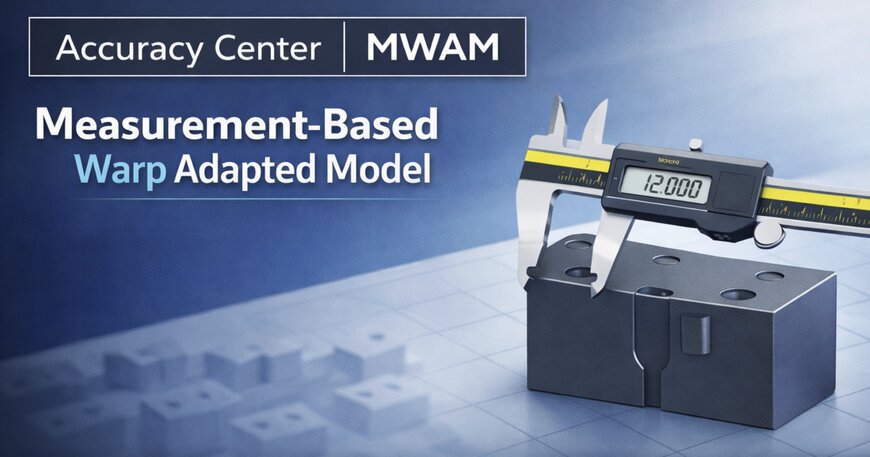
A new feature integrated into additive manufacturing software introduces measurement-based warpage correction, improving dimensional accuracy in printed parts. By incorporating measured dimensional data into the print preparation process, the system automatically compensates for deformation during fabrication.
This approach is particularly relevant for complex geometries such as electrical connectors and precision tooling, where deviations from nominal dimensions can lead to functional issues. The integration of this capability within a digital supply chain supports consistent production outcomes and reduces the need for iterative reprints.
SLA Materials for High-Detail Prototyping
A new stereolithography (SLA) material expands capabilities for producing detailed, moisture-resistant prototypes. The material provides a smooth surface finish and dimensional stability, making it suitable for applications in aerospace, automotive, and industrial design.
Compatibility with large-format SLA systems enables the production of sizable prototypes while maintaining fine feature resolution. This supports both visual modelling and functional testing under realistic environmental conditions.
Supporting Industrial Additive Manufacturing Adoption
The combined introduction of advanced materials and process-enhancing software reflects a broader trend toward production-grade additive manufacturing. By addressing limitations related to material performance, dimensional accuracy, and workflow integration, these developments support wider adoption across industrial sectors.
As additive manufacturing becomes increasingly integrated into the automotive data ecosystem and other production environments, such improvements enable manufacturers to transition from prototyping to end-use part production with greater reliability and efficiency.
Edited by Romila DSilva, Induportals Editor, with AI assistance.
www.stratasys.com
