
metalworkingmag.com
14
'26
Written on Modified on
Additive Manufacturing Scales with Integrated Production Platforms
3D Systems introduces new hardware and software at RAPID + TCT 2026 to enable high-throughput, controlled additive manufacturing in industrial production environments.
www.3dsystems.com
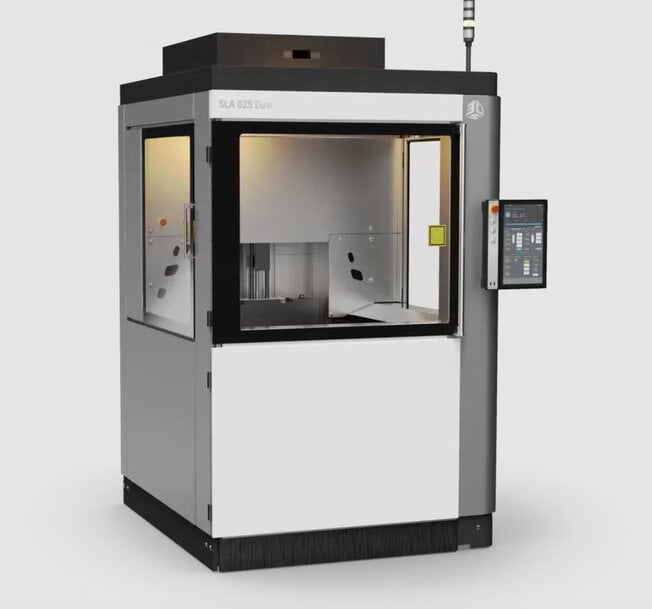
SLA 825 Dual 3D Printer
Advancing production-ready additive manufacturing
As additive manufacturing transitions from prototyping to production, manufacturers require consistent output, higher utilization rates, and integrated workflows. 3D Systems’ latest developments address these requirements by combining printing hardware, software platforms, and application expertise into a unified production ecosystem.
This approach supports a digital supply chain, where additive systems are integrated into broader manufacturing processes, enabling on-demand production and reducing dependency on traditional inventory models.
Increased throughput with stereolithography systems
The SLA 825 Dual stereolithography system is designed for high-utilization production environments. It features a 22% larger build volume and delivers up to 25% faster build speeds compared to its predecessor, enabling more builds per shift and higher part consolidation per platform.
These improvements support applications where dimensional accuracy and repeatability are critical, including motorsports components, precision prototyping, and investment casting patterns. By maintaining stereolithography precision while increasing output, the system enables manufacturers to scale production workflows without compromising quality.
Centralized control with factory-level software integration
To support scaling, 3D Systems introduced AddiTrak, an on-premises software platform designed to manage connected additive manufacturing environments. The platform provides centralized monitoring, analytics, and optimization through a unified interface.
AddiTrak supports Industry 4.0-compatible communication standards such as MTConnect and OPC UA, enabling interoperability across production systems. Integration with 3D Sprint software allows end-to-end workflow management, including job preparation, scheduling, build execution, and performance analysis.
This level of connectivity enhances visibility across the production floor, enabling manufacturers to monitor machine utilization, identify inefficiencies, and maintain consistent output across multiple systems.
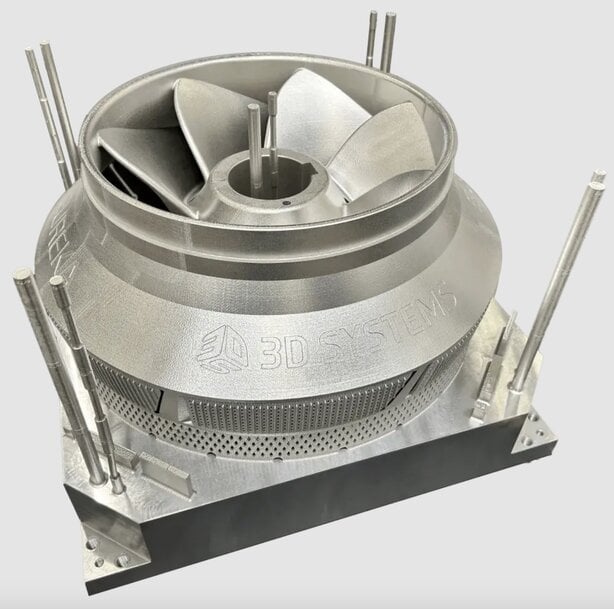
DMP 500 Build on Plate
Enabling secure and controlled production environments
Data security and process control are critical in industrial additive manufacturing. AddiTrak operates as a fully on-premises solution, allowing manufacturers to retain control over sensitive design and production data.
Combined with centralized analytics, this architecture supports traceability and quality assurance, which are essential for regulated industries and high-value production applications.
Application example: on-demand spare parts production
3D Systems also presented production use cases demonstrating the role of additive manufacturing in addressing supply chain challenges. One example involves Eureka Pumps AS, which uses direct metal printing technology to manufacture large-format spare parts on demand.
This approach reduces lead times and minimizes the need for physical inventory, improving responsiveness in mission-critical environments. By producing components as needed, manufacturers can mitigate part obsolescence and reduce working capital requirements, strengthening the resilience of the digital supply chain.
Edited by Romila DSilva, Induportals Editor, with AI assistance.
www.3dsystems.com
