
metalworkingmag.com
25
'26
Written on Modified on
Modular Tooling System for Precision Machining
Tungaloy expands the TungMeister series with new cylindrical blanks for exchangeable-head tools designed for flexible machining and lower tooling costs.
tungaloy.com
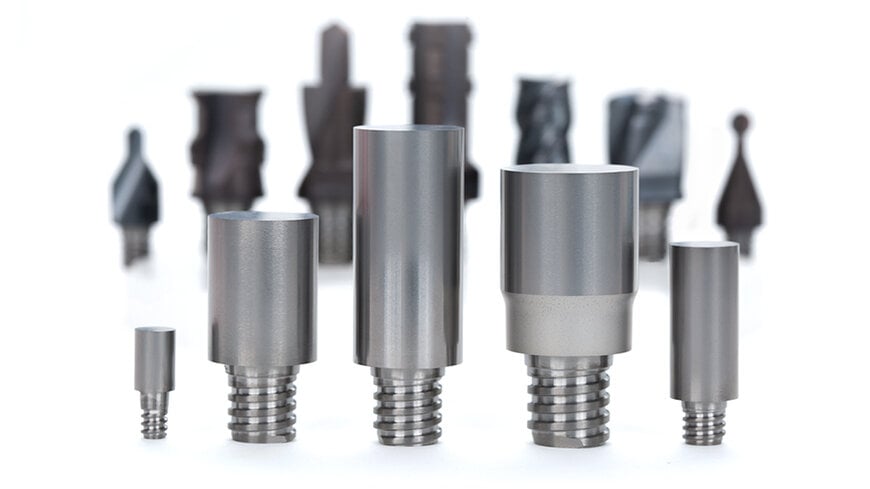
Tungaloy Corporation has expanded its TungMeister series with new cylindrical blanks for exchangeable-head tools. The new additions are intended to improve flexibility in special tool design, reduce tooling costs, and extend tool life in precision machining applications.
The development targets industries such as aerospace, automotive, precision engineering, and industrial component manufacturing, where deep machining and long-overhang operations are common. The solution reflects the growing adoption of modular tooling systems aimed at improving manufacturing efficiency and reducing carbide material consumption.
Expanded Cylindrical Blank Range for Specialized Machining
TungMeister is an exchangeable-head end mill system designed to maintain high machining precision while reducing setup and tool replacement times. The platform includes more than 45 head geometries and supports tool diameters ranging from 5 mm to 32 mm.
The latest expansion introduces cylindrical blanks in diameters from 6 mm to 20 mm, enabling the design of specialized tools for a broader range of machining applications involving small- and medium-diameter workpieces.
According to Tungaloy, the expanded lineup allows manufacturers to develop customized cutting geometries while maintaining stable cutting performance. This approach enables specialized machining operations without relying entirely on custom solid carbide end mills.
Cost Reduction and Support for Long-Reach Machining
One of the primary objectives of the new blanks is to reduce costs associated with special solid carbide tooling. Only the cutting head requires a custom geometry, while the shank section can utilize standard components.
The use of standard shanks also shortens production lead times and provides flexibility in selecting suitable overhang lengths for deep machining and long-reach operations.
Conventional solid carbide end mills are often constrained by the available carbide material length, limiting their suitability for deep cavity machining or applications requiring extended tool reach. The modular TungMeister structure addresses this limitation by allowing interchangeable use of various standard shanks depending on machining requirements.
Exchangeable-Head Structure Reduces Setup Time
The TungMeister system uses an exchangeable-head design intended to minimize machine downtime during tool replacement. When the cutting edge becomes worn, only the head section is replaced instead of the complete tool assembly.
This structure reduces setup time and improves machine availability in automated manufacturing environments. It also simplifies maintenance procedures and tooling inventory management.
In high-volume production environments, reducing tool replacement time is an important factor in maintaining productivity and minimizing interruptions. Exchangeable-head tooling systems are increasingly integrated into digital manufacturing and flexible machining strategies for this reason.
Additional Context: Technical Specifications and Competitive Benchmarking
Exchangeable-head milling systems are widely used in CNC machining to improve tooling flexibility and reduce overall tooling costs. Comparable systems include Sandvik Coromant’s Coromant Capto, ISCAR’s Multi-Master platform, and Seco’s modular tooling solutions.
Key benchmarking criteria for these systems include clamping rigidity, repeatability accuracy, available diameter range, support for deep machining applications, and tool replacement time.
The TungMeister platform supports cutting diameters from 5 mm to 32 mm and includes more than 45 interchangeable head geometries, positioning it for flexible milling applications requiring rapid tool adaptation. Competing systems similarly focus on modular interfaces that reduce dependence on custom solid carbide tools and improve maintenance efficiency.
Rising carbide material costs continue to accelerate the adoption of modular tooling architectures, particularly in industries requiring specialized cutting tools or long-overhang machining configurations.
Edited by Sucithra Mani, Induportals editor – adapted by AI.
www.tungaloy.com
