
metalworkingmag.com
28
'26
Written on Modified on
SpinJet transforms existing machine into high-speed machine
Tungaloy's SpinJet is a speed-increasing spindle that enables high-speed rotation of small-diameter tools and high-efficiency machining when mounted on existing machine tools.
tungaloy.com
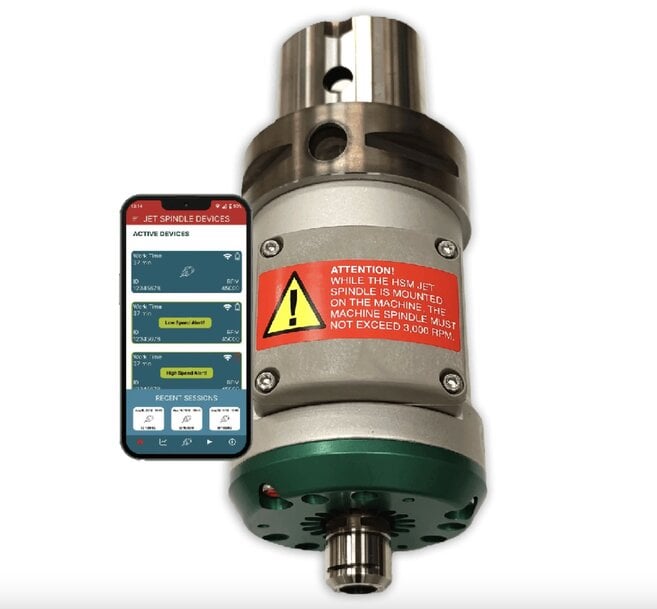
Tungaloy announces the expansion of its SpinJet series, featuring a new generation model equipped with a cartridge-type design and app-based spindle speed monitoring, enabling cost reduction, simplified maintenance, and enhanced machining efficiency across various machine interfaces.
The integration of dedicated velocity-multiplying modules into legacy computer numerical control machining centers serves as a primary method for upgrading small-diameter milling and drilling efficiency without replacing fundamental capital infrastructure. General-purpose machine tools are often limited by low maximum spindle rotational speeds, resulting in substandard surface feet per minute cutting conditions when deploying micro-diameter tools. To rectify this operational discrepancy, integrated fluid-driven auxiliary spindles utilize existing high-pressure cutting fluid pumps as an active energy source, generating high rotational velocities while maintaining the primary machine spindle in a stationary, idle state.
Kinetic Energy Conversion and Thermal Stabilization Dynamics
Operating miniature cutting tools below their engineered cutting velocities causes accelerated tool wear, irregular surface finishes, and reduced throughput across automotive, die and mold, and heavy manufacturing sectors. The deployment of the SpinJet series addresses this by routing the machine tool's through-spindle cutting fluid into an internal high-efficiency turbine. This mechanism converts physical hydraulic pressure into rotational torque, accelerating small-diameter cutting tools up to necessary high-speed machining velocities. By relying purely on the kinetic delivery of the cutting fluid, the system functions as an energy-saving speed increaser, isolating the main machine spindle bearings from high-frequency mechanical friction and thermal distortion.
Simultaneously, the continuous volumetric discharge of the high-pressure cutting fluid operates as a dual-action thermal stabilization media. As the fluid exhausts through the integrated nozzle assembly immediately adjacent to the tool cutting edge, it acts as a strong localized cooling and chip-evacuation jet. This continuous flushing action eliminates thermal micro-cracking at the tool-workpiece interface and prevents the recutting of metal chips, which directly increases tool service lifecycles and preserves physical dimensional accuracy during extended finishing loops.
Cartridge Architecture and Heterogeneous Interface Adaptability
Conventional high-speed speeder attachments typically construct the driving mechanism and the machine interface as a solid, monolithic housing. In the event of an internal bearing failure or a change in machine infrastructure, this unified topology obligates operators to purchase completely new assemblies. To eliminate this maintenance capital expenditure, the latest generation of this tooling portfolio adopts a modular cartridge-type spindle architecture. This structural standardization isolates the core spindle drive unit into a distinct, replaceable capsule that can be swapped out independently during service routines:
- Drive Standardization: The internal turbine and precision bearing package are housed in a uniform cylindrical cartridge, enabling rapid structural swap-outs in the event of an operational failure.
- Cross-Platform Versatility: The standardized cartridge can be decoupled and shared between distinct machine interface adapters, maximizing structural hardware flexibility across varied workshop assets.
- Interface Compatibility: The modular backing adapters natively support a broad matrix of industrial machine interfaces, including ER32 collet chucks, BT40, HSK-A63, C6, ST20, and CAT40 tapers.
By permitting direct, plug-and-play mounting onto existing machine tool carousels, this modular configuration allows job shops to deploy uniform high-speed cutting parameters across a heterogeneous machine floor, minimizing initial capital requirements while optimizing overall equipment effectiveness.
Telemetry Integration and Cost Reduction Mechanics
Traditional high-speed mechanical or turbine speeders require dedicated, external physical telemetry consoles or specialized stationary receivers to monitor real-time tool rotational speeds during cutting operations. These legacy display instruments add to the initial implementation cost and complicate layout management within the machine enclosure. This portfolio bypasses separate telemetry hardware by shifting speed calculations to an integrated wireless transmitter that syncs directly with a free, downloadable mobile software application.
The integrated electronic module embedded inside the tool casing samples internal rotational frequencies and broadcasts real-time data directly to standard smartphones or tablets. This localized digital link provides machine operators with immediate visibility into actual cutting speeds under load, facilitating precise feed-per-tooth monitoring and early detection of pressure-induced stalls. The elimination of auxiliary monitoring hardware, paired with the direct machine-integration capabilities of the cartridge design, significantly reduces initial implementation expenses and ongoing operational management workloads.
Additional Context
This section details technical specifications and competitive benchmarking not included in the original news release.
Telemetry Integration and Cost Reduction Mechanics
Traditional high-speed mechanical or turbine speeders require dedicated, external physical telemetry consoles or specialized stationary receivers to monitor real-time tool rotational speeds during cutting operations. These legacy display instruments add to the initial implementation cost and complicate layout management within the machine enclosure. This portfolio bypasses separate telemetry hardware by shifting speed calculations to an integrated wireless transmitter that syncs directly with a free, downloadable mobile software application.
The integrated electronic module embedded inside the tool casing samples internal rotational frequencies and broadcasts real-time data directly to standard smartphones or tablets. This localized digital link provides machine operators with immediate visibility into actual cutting speeds under load, facilitating precise feed-per-tooth monitoring and early detection of pressure-induced stalls. The elimination of auxiliary monitoring hardware, paired with the direct machine-integration capabilities of the cartridge design, significantly reduces initial implementation expenses and ongoing operational management workloads.
Additional Context
This section details technical specifications and competitive benchmarking not included in the original news release.
Based on the technical features and market benchmarks, the new generation Tungaloy SpinJet presents several distinct operational and economic advantages over comparable high-speed auxiliary spindles:
- Lower Maintenance Costs and Higher Component Versatility: Unlike single-piece compact alternatives such as the CoolSpeed Mini Tool Line, which integrate the turbine core and mounting block into a single structure, the SpinJet utilizes a standardized, modular cartridge design. In the event of a mechanical or turbine failure, operators can replace the standalone spindle drive cartridge independently rather than purchasing an entirely new system. This design also allows a single spindle core to be shared among different machine toolholder interfaces (such as ER32, BT40, and HSK-A63), increasing asset versatility across the shop floor.
- Reduced Installation and Monitoring Costs: Traditional high-speed speeders require the separate procurement of a dedicated external hardware monitor or physical tachometer to measure actual rotational cutting speeds on the machine. The SpinJet eliminates this hardware bottleneck by embedding a wireless transmitter inside its steel casing to broadcast real-time telemetry directly to a free smartphone or tablet application. This completely eliminates the installation overhead and logistical management of specialized monitoring hardware.
- Lower Implementation and Auxiliary System Costs: When compared to high-frequency electric alternatives like the iSpeed5 Modular System, the SpinJet is completely plug-and-play and operates as a purely mechanical, energy-efficient accessory. It requires no external electric motor wiring or expensive stationary stop blocks on the machine spindle face to transfer power and signals. Furthermore, by relying directly on the host machine's existing coolant pressure to drive its internal micro-turbine, it provides active coolant jet stream cooling that actively extends small-diameter tool life and stabilizes machining parameters simultaneously.
