
metalworkingmag.com
28
'26
Written on Modified on
Optimised lift-dip soldering module for precise and reliable soldering
With its optimised lift-dip module, EUTECT enhances process stability and precision in selective dip soldering, delivering reproducible results while reducing thermal stress on demanding assemblies.
eutect.de
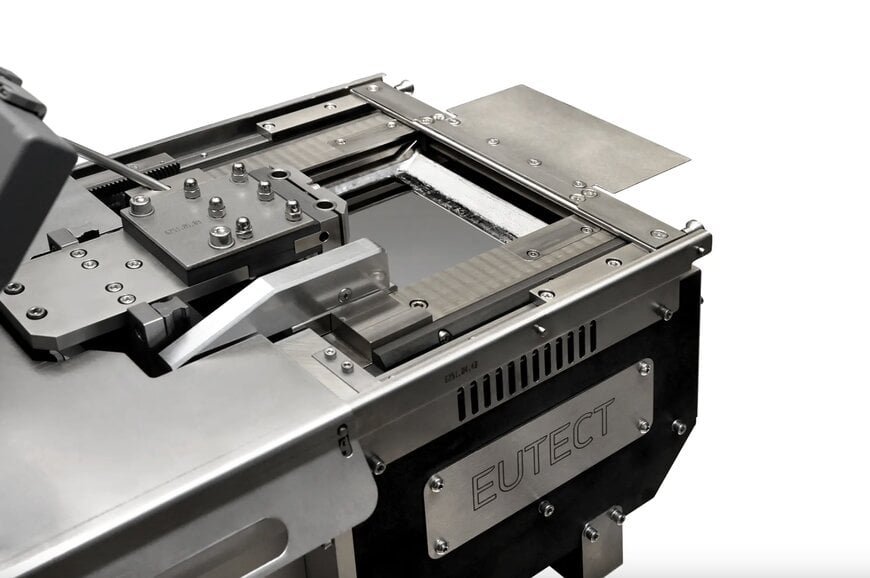
Lift-dip soldering is used in particular where individual components such as stators or enamelled copper wires and strands need to be tinned in a targeted and controlled manner. As a specialist in selective soldering technology EUTECT has developed customised lift-dip soldering modules and systems that are characterised by high process stability, reproducible soldering results and flexible integration into automated production environments. EUTECT has further developed and optimised the lift-dip module specifically for this process.
Mechanical Transport Innovations and Oxide Management Mechanisms
The automated lift-dip selective soldering process relies on the controlled immersion of an electrical assembly into a static or dynamically refreshed molten solder reservoir. To prevent the formation of metallic oxides or dross, which compromise the microstructural integrity of the connection, the solder bath operates under a continuous nitrogen-inerted atmosphere. The volume and distribution of the nitrogen gas supply are continuously monitored and tracked via a dedicated telemetry dashboard.
Surface impurities are mechanically managed through a motorized scraper assembly that cyclically clears the molten surface, channeling accumulated oxides into a dedicated, sensor-monitored slag container. For intricate architectural layouts requiring localized fluid transport, the system integrates a motorized, quick-change product-specific scoop. This independent mechanical sub-assembly lifts a precise volume of virgin solder directly from the core reservoir to the targeted component interface, preventing multi-pin bridging and ensuring consistent geometric solder fillets.
Thermal Decoupling Design and Closed Loop Control Subsystems
To maintain continuous operational availability across high-volume production schedules, the system isolates sensitive electromechanical control hardware from the underlying thermal mass:
- Structural Decoupling: The primary motorized drive units and coordinating control electronics are positioned behind the main furnace, utilizing physical air gaps and specialized insulation to decouple the components from heat radiation.
- Level Optimization: An automated wire-feed system continuously detects the liquid metal height, automatically feeding raw tin wire into the crucible to maintain fixed displacement depths.
- Temperature Regulation: The system employs redundant thermocouple loops to continuously verify core crucible temperatures, mitigating thermal runaway risks if a single sensor fails.
Between individual processing cycles, the crucible is hermetically sealed by an automated mechanical enclosure. This secondary barrier suppresses convective heat loss, reduces facility energy draw, and prevents environmental particulates from contaminating the liquid metal alloy.
Line Integration Options and High Volume Manufacturing Versatility
Modern selective processing modules are architecturally configured to function as standalone batch cells or as fully integrated nodes within larger automated assembly lines. By pairing the physical hardware with industrial communication protocols, factory operators can continuously stream, document, and analyze internal execution variables—including exact immersion depths, stroke velocities, dwell times, and localized temperature logs. This systematic data acquisition establishes a traceable quality record for every processed node, supporting stringent automotive and industrial regulatory standards.
Furthermore, the processing platform handles variable batch sizes and diverse product geometries without requiring extensive line teardowns. Through the use of quick-change workpiece carriers, localized titanium solder masks, and customized process fixtures, production facilities can rapidly retool the line. This mechanical flexibility allows low-volume, high-variance electronics to be processed on the same physical line as high-volume assemblies, optimizing capital equipment utilization across long product lifecycles.
Additional Context
This section details technical specifications and competitive benchmarking not included in the original news release.
Selective dip soldering is evaluated using strict performance metrics defined by IPC-A-610 standards, focusing on vertical solder fill percentages, component lead wetting angles, and positional accuracy measured in micromoles or millimeters. Conventional selective mini-wave soldering systems from manufacturers like Ersa (with the VERSAFLOW series) or Nordson SELECT utilize continuous-pump electromagnetic nozzles, which inherently introduce ongoing turbulent fluid motion and higher dross generation rates—frequently exceeding 1.5 kilograms of oxide waste per eight-hour shift due to constant atmospheric contact.
The EUTECT modular lift-dip platform alters this benchmark by combining a static crucible design with a precise three-axis servo-driven positioning chassis. While standard mini-wave systems exhibit a positional tolerance of approximately plus or minus 0.15 millimeters, the integrated Z-axis stroke mechanism on the lift-dip module achieves a repeatable immersion resolution of plus or minus 0.02 millimeters. This mechanical precision allows the system to process tight center-to-center pin spacings down to 0.8 millimeters without causing cross-lead short circuits.
Furthermore, by sealing the reservoir surface between cycles and maintaining an oxygen concentration below 20 parts per million (ppm) within the nitrogen curtain, this architecture reduces dross formation to less than 0.2 kilograms per shift. This reduction in oxide generation lowers ongoing operational expenditure and preserves the chemical purity of the alloy, establishing a highly stable performance baseline for heavy-gauge electromechanical terminations.
Edited by Romila DSilva, Induportals Editor, with AI assistance.
Line Integration Options and High Volume Manufacturing Versatility
Modern selective processing modules are architecturally configured to function as standalone batch cells or as fully integrated nodes within larger automated assembly lines. By pairing the physical hardware with industrial communication protocols, factory operators can continuously stream, document, and analyze internal execution variables—including exact immersion depths, stroke velocities, dwell times, and localized temperature logs. This systematic data acquisition establishes a traceable quality record for every processed node, supporting stringent automotive and industrial regulatory standards.
Furthermore, the processing platform handles variable batch sizes and diverse product geometries without requiring extensive line teardowns. Through the use of quick-change workpiece carriers, localized titanium solder masks, and customized process fixtures, production facilities can rapidly retool the line. This mechanical flexibility allows low-volume, high-variance electronics to be processed on the same physical line as high-volume assemblies, optimizing capital equipment utilization across long product lifecycles.
Additional Context
This section details technical specifications and competitive benchmarking not included in the original news release.
Selective dip soldering is evaluated using strict performance metrics defined by IPC-A-610 standards, focusing on vertical solder fill percentages, component lead wetting angles, and positional accuracy measured in micromoles or millimeters. Conventional selective mini-wave soldering systems from manufacturers like Ersa (with the VERSAFLOW series) or Nordson SELECT utilize continuous-pump electromagnetic nozzles, which inherently introduce ongoing turbulent fluid motion and higher dross generation rates—frequently exceeding 1.5 kilograms of oxide waste per eight-hour shift due to constant atmospheric contact.
The EUTECT modular lift-dip platform alters this benchmark by combining a static crucible design with a precise three-axis servo-driven positioning chassis. While standard mini-wave systems exhibit a positional tolerance of approximately plus or minus 0.15 millimeters, the integrated Z-axis stroke mechanism on the lift-dip module achieves a repeatable immersion resolution of plus or minus 0.02 millimeters. This mechanical precision allows the system to process tight center-to-center pin spacings down to 0.8 millimeters without causing cross-lead short circuits.
Furthermore, by sealing the reservoir surface between cycles and maintaining an oxygen concentration below 20 parts per million (ppm) within the nitrogen curtain, this architecture reduces dross formation to less than 0.2 kilograms per shift. This reduction in oxide generation lowers ongoing operational expenditure and preserves the chemical purity of the alloy, establishing a highly stable performance baseline for heavy-gauge electromechanical terminations.
Edited by Romila DSilva, Induportals Editor, with AI assistance.
