
metalworkingmag.com
02
'26
Written on Modified on
Tungaloy Expands DS2000 DLC-Coated Insert Lineup for Non-Ferrous Machining
With its excellent resistance to welding, the DS2000 Series suppresses the formation of built-up edges, while its high coating adhesion significantly reduces coating delamination.
tungaloy.com
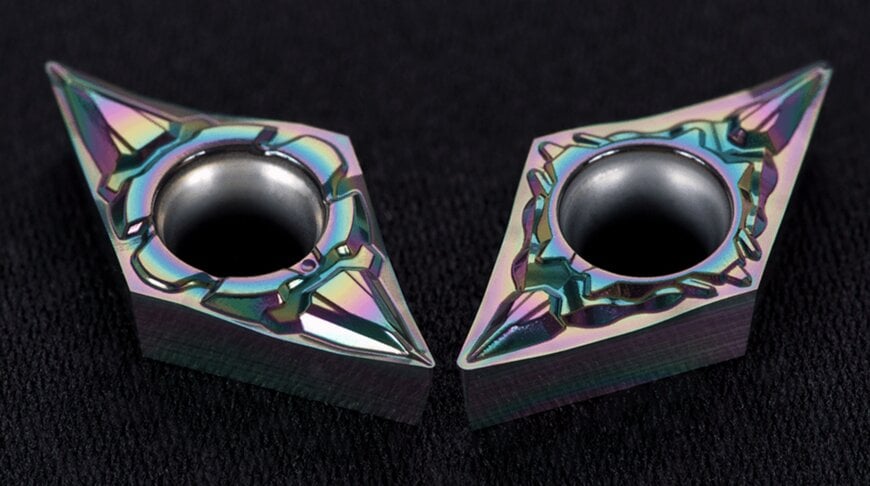
Tungaloy has expanded its DS2000 series of diamond-like carbon (DLC) coated insert grades, introducing new chipbreaker geometries and threading profiles designed specifically for precision small-part machining of non-ferrous metals like aluminum alloys.
Machining Challenges in Non-Ferrous Materials
In the precision and small-parts manufacturing sectors, components such as valves, connectors, pump components, and semiconductor manufacturing equipment parts are routinely machined from non-ferrous materials, including aluminum and copper alloys. Processing these materials on automatic lathes or compact CNC lathes demands high dimensional accuracy and superior surface finishes.
However, conventional manufacturing faces significant material-specific obstacles. Non-ferrous alloys frequently generate long, continuous chips that tend to wrap around the workpiece. Additionally, these materials are prone to built-up edge (BUE) formation and material welding along the cutting edge, which directly degrades surface roughness. Standard uncoated carbide grades and conventional DLC-coated grades often exhibit limited tool life and insufficient stability under high-speed or mass-production conditions. This has driven industrial demand for targeted chipbreakers and specialized coating grades optimized for small-part machining.
DS2000 Series Coating Technology
The DS2000 series utilizes Tungaloy's proprietary DLC coating technology to address these wear mechanisms. The coating is engineered with high welding resistance to suppress built-up edges and features enhanced coating adhesion properties to prevent delamination from the carbide substrate. Furthermore, the high hardness and thermal resistance of the coating layer delay the progression of flank and rake face wear, extending overall tool life and stabilizing operations across diverse non-ferrous turning applications.
Geometry and Chipbreaker Extensions
The expanded product line introduces new insert geometries engineered for distinct chip-control requirements:
- JS and JP-Type Chipbreakers: Developed for precision and small-part machining, these inserts utilize a G-class 3D breaker design to optimize chip flow. The geometry features unique protrusion structures that maintain stable chip evacuation even when operating at shallow depths of cut and low feed rates, delivering high surface quality during finishing and precision finishing phases.
- AL-Type Chipbreaker: positionable as a primary choice for non-ferrous machining, this design features a large rake angle and a sharp cutting edge to minimize cutting forces. It incorporates a large inclination angle cutting-edge geometry coupled with an optimized chipbreaker form for controlled chip evacuation. Resistance to built-up edge is further reinforced through a mirror-finished rake face working in tandem with the DLC layer.
- Threading Inserts with Finishing Edge: Designed for high-precision thread machining, these inserts feature a finishing-edge profile compliant with ISO metric thread standards to maximize profile accuracy. The configuration limits material adhesion to preserve thread surface gloss, maintain dimensional stability, and ensure reliability during continuous automated operations.
Additional Context
This section details technical specifications not included in the original news release.
Diamond-Like Carbon (DLC) coatings are amorphous carbon-based thin films that exhibit a high concentration of sp3 tetrahedral diamond bonds alongside sp2 graphite bonds. This composition provides a unique combination of mechanical properties, characterized by high nano-hardness—typically ranging from 15 GPa to over 80 GPa depending on whether the structure is hydrogenated or hydrogen-free and an exceptionally low coefficient of friction, usually between 0.05 and 0.25 against steel and non-ferrous metals.
The low coefficient of friction imparts a self-lubricating property to the cutting tool surface. This is critical when machining ductile non-ferrous materials like aluminum alloys (such as 6061 or A356) and copper, which have high chemical affinity for substrate metals like tungsten carbide. By eliminating direct metal-to-metal contact, the DLC layer prevents localized adhesion and cold welding. Thermal stability for standard industrial DLC coatings is maintained at operating temperatures up to approximately 400°C to 500°C, beyond which the metastable sp3 bonds begin to graphitize into sp2 arrangements. The coatings are typically applied via Physical Vapor Deposition (PVD), such as cathodic arc evaporation or magnetron sputtering, or Plasma-Assisted Chemical Vapor Deposition (PACVD), yielding a thin uniform layer generally measuring between 1 µm and 5 µm in thickness to preserve the sharpness of micro-precision cutting edges.
Edited by Romila DSilva, Induportals Editor, with AI assistance.
This section details technical specifications not included in the original news release.
Diamond-Like Carbon (DLC) coatings are amorphous carbon-based thin films that exhibit a high concentration of sp3 tetrahedral diamond bonds alongside sp2 graphite bonds. This composition provides a unique combination of mechanical properties, characterized by high nano-hardness—typically ranging from 15 GPa to over 80 GPa depending on whether the structure is hydrogenated or hydrogen-free and an exceptionally low coefficient of friction, usually between 0.05 and 0.25 against steel and non-ferrous metals.
The low coefficient of friction imparts a self-lubricating property to the cutting tool surface. This is critical when machining ductile non-ferrous materials like aluminum alloys (such as 6061 or A356) and copper, which have high chemical affinity for substrate metals like tungsten carbide. By eliminating direct metal-to-metal contact, the DLC layer prevents localized adhesion and cold welding. Thermal stability for standard industrial DLC coatings is maintained at operating temperatures up to approximately 400°C to 500°C, beyond which the metastable sp3 bonds begin to graphitize into sp2 arrangements. The coatings are typically applied via Physical Vapor Deposition (PVD), such as cathodic arc evaporation or magnetron sputtering, or Plasma-Assisted Chemical Vapor Deposition (PACVD), yielding a thin uniform layer generally measuring between 1 µm and 5 µm in thickness to preserve the sharpness of micro-precision cutting edges.
Edited by Romila DSilva, Induportals Editor, with AI assistance.
