
metalworkingmag.com
01
'26
Written on Modified on
Nidec Launches New Versatile Multi Tasking Machine
The newly released TEX-2500S multi-tasking machine delivers fast machining speeds, advanced automation options, and a space-saving design to optimize high-mix small-lot production lines.
www.nidec.com
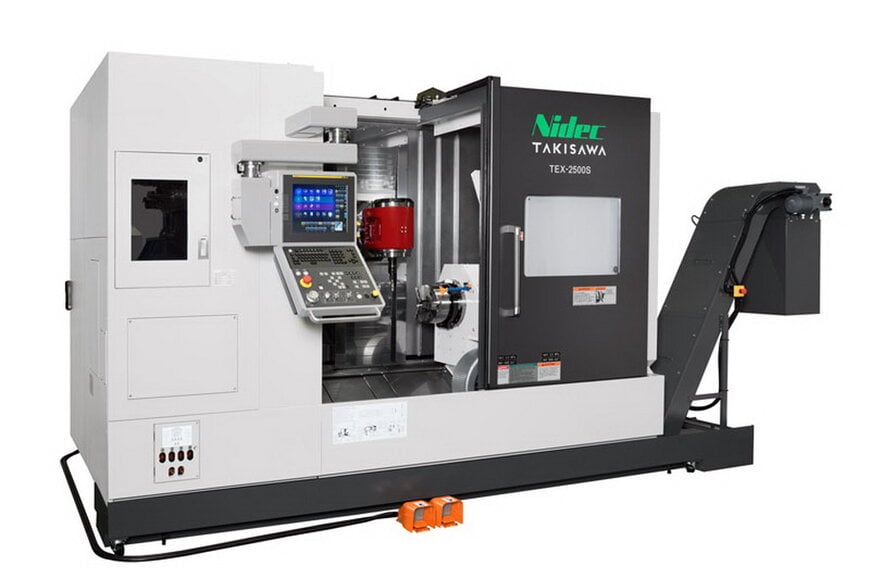
Nidec Group Member Takisawa Machine Tool Co., Ltd. has commenced the full-scale commercial release of its new mid-tier machining platform designed to bridge the operational gap between standard computer numerical control turning centers and advanced multi-tasking manufacturing systems.
Architectural Integration of Multi-Tasking Mechanisms
Modern industrial production increasingly requires facilities to manage high-mix, small-lot manufacturing within constrained factory floor areas. The development of the TEX-2500S multi-tasking machine addresses these requirements by integrating an opposed twin-spindle configuration with a dedicated tool spindle. This mechanical architecture allows a single manufacturing platform to process complex geometries ranging from standard turned components to precise gear profiles. By combining the high-speed rotational processing of a production turret lathe with the kinematic flexibility of an automatic tool changer, the system allows factories to transition from multi-process setups to a unified, automated manufacturing sequence.
Kinematic Refinements and Volumetric Efficiency
Engineering optimization of the system focuses heavily on maximizing internal machining space while reducing the physical machine footprint. The tool spindle features a compact design that is 15% shorter than those found in conventional turning platforms. This reduction in spindle length increases the internal volumetric clearance, allowing the right-hand work spindle to execute rotational positioning and movement at any angle while the X-axis remains stationed at its home origin. This specific kinematic relationship eliminates the need for long tool retraction or evacuation paths, directly shortening non-cutting cycle times during automated transitions.
Tool replenishment speeds have also been modified through an alternative tool magazine architecture. The layout allows for tool exchange sequences to occur without requiring a complete slewing or rotation of the main tool spindle. As a result of this configuration, tool-to-tool exchange times are reduced by 14% compared to legacy designs, improving the continuity of autonomous machining operations.
Mechanical Rigidity and Spatial Optimization
The structural design inherits core physical attributes from high-end multi-tasking series, utilizing a bed structure engineered to resist thermal displacement and maintain dimensional accuracy under heavy cutting loads. The machine accommodates a 10-inch chuck on both the left and right spindles, offering a maximum turning diameter of 400 millimeters and a maximum turning length of 1,100 millimeters. Bar material capacity is rated at a diameter of 80 millimeters, and both spindles operate at maximum rotational speeds of 4,000 revolutions per minute.
For facilities with limited floor area, the physical enclosure has been compressed to require a total width of 5,505 millimeters, a depth of 3,220 millimeters, and a height of 2,552 millimeters. This specialized layout yields an approximate 30% reduction in total machine footprint relative to older models of equivalent capacity. To support extended high-mix manufacturing without operator intervention, the standard internal automatic tool changer chain stores 30 tools, with an optional expansion capability up to 60 tools. Automation integration is further supported by an optional parts catcher coupled with a discharge conveyor for consecutive bar stock machining, alongside an automatic tool setter to monitor tool wear and minimize process interruptions.
Additional Context: Technical Specifications and Competitive Benchmarking
In the global multi-tasking machine tool segment, mid-class twin-spindle systems with automatic tool changers compete directly with established platforms such as the Yamazaki Mazak Integrex series and the DMG Mori NTX series. Benchmarking these systems involves evaluating structural footprint efficiency, tool capacity, spindle speed, and tool exchange mechanics.
- Footprint Area: The Takisawa TEX-2500S occupies 17.73 square meters, whereas typical mid-class competitors average a larger footprint of 23.50 to 25.00 square meters.
- Tool Spindle Length Reduction: The TEX-2500S features a spindle length that is 15% lower than the baseline, while competitors remain at the standard baseline reference.
- Tool-to-Tool Change Speed: The TEX-2500S operates 14% faster than legacy models, outperforming the standard mechanical index time of typical competitors.
- Standard Tool Storage: The TEX-2500S holds 30 pieces standard with a 60-piece maximum capacity, while competitors typically average 36 to 40 pieces as their standard configuration.
- Maximum Turning Diameter: The TEX-2500S provides a 400-millimeter capacity, positioning it squarely within the competitor average range of 380 to 450 millimeters.
- Spindle Speed (Left/Right): Both the left and right spindles on the TEX-2500S run at a maximum of 4,000 revolutions per minute, compared to a competitor average range of 4,000 to 5,000 revolutions per minute.
The 30% reduction in factory floor footprint achieved by the TEX-2500S positions the platform below the typical 23 to 25 square meter floor requirement of equivalent 10-inch chuck twin-spindle multi-tasking machines. While standard competitor models frequently offer larger base tool magazines, the slewing-free tool exchange mechanism of this platform optimizes the non-cutting intervals to achieve a 14% efficiency gain over older internal mechanics, making it highly competitive for rapid, high-volume component manufacturing.
Edited by Evgeny Churilov, Induportals Media - Adapted by AI.
www.takisawa.co.jp
Edited by Evgeny Churilov, Induportals Media - Adapted by AI.
www.takisawa.co.jp
