
metalworkingmag.com
21
'26
Written on Modified on
Optimizing CNC Spindle Drawbar Monitoring With IO-Link Sensors
Contrinex smart position sensors replace multi-device mechanical assemblies with continuous digital tracking to reduce downtime and improve spindle reliability.
www.us.contrinex.com
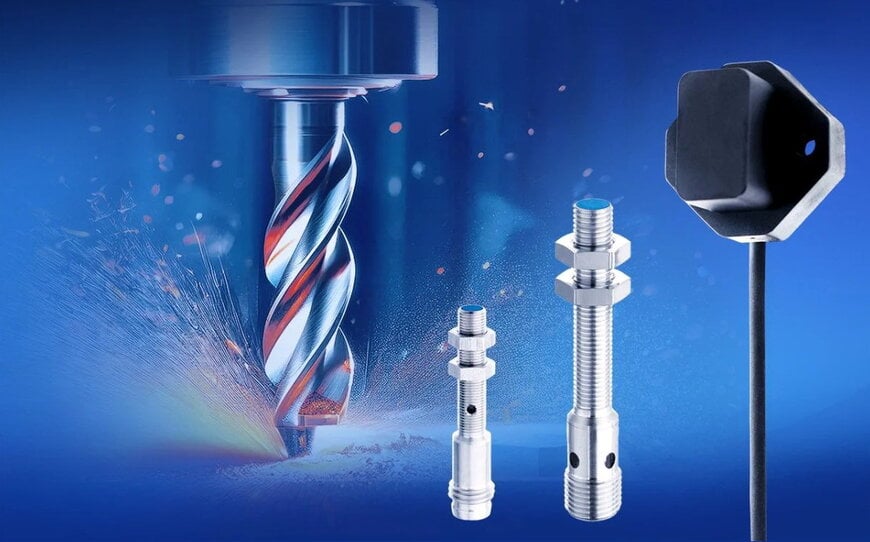
In automated CNC machining operations, spindle drawbar reliability is essential to prevent tool-throw incidents, part damage, and unplanned downtime. To verify tool clamping, machine controllers must reliably detect three mechanical states: unclamped for tool exchange, clamped with a tool present, and clamped without a tool.
Conventional configurations rely on three separate inductive proximity switches mounted on dedicated mechanical brackets inside the spindle housing. Because modern spindles provide minimal internal clearance, fitting multiple brackets, routing individual cables, and setting discrete mechanical trip points creates substantial assembly bottlenecks. Furthermore, continuous high-vibration machining environments cause physical brackets to drift over time. Shifts of less than a millimeter can trigger false alarms during tool change cycles, halting production and requiring manual technician intervention to recalibrate switches.
Consolidating Multi-Switch Setups into a Single Measurement Device
To address mechanical drift and spatial constraints, machine builders and operators are adopting Contrinex smart position sensors as a consolidated monitoring solution. Rather than monitoring discrete physical points through separate proximity switches, the deployment uses a single high-precision measuring sensor operating over IO-Link to continuously track the full drawbar stroke.
Continuous travel monitoring provides an absolute position readout throughout the entire clamping sequence. Machine controllers establish the three critical operational positions digitally via configuration software, eliminating the need for manual mechanical adjustments inside the spindle envelope.
Technical Benefits of IO-Link Integration
Integrating IO-Link enabled measurement devices introduces digital parameterization, diagnostics, and process transparency directly into the machine automation architecture:
- Software-Based Calibration: Technicians set and adjust switching thresholds digitally, removing the requirement to access mechanical brackets with manual tools.
- Continuous Stroke Tracking: Absolute distance measurements allow the controller to assess stroke velocity, position repeatability, and clamping consistency, identifying mechanical degradation prior to hardware failure.
- Automated Device Replacement: When a replacement sensor is installed, the IO-Link master downloads existing parameters automatically, eliminating manual reconfiguration and speeding up maintenance turnaround.
- Condition Diagnostics: Built-in internal temperature monitoring and diagnostic alerts track environmental stress levels inside the spindle assembly, supporting predictive maintenance workflows.
Long-Term Maintenance and Reliability Improvements
Consolidating three mechanical switches into a single smart sensor reduces physical mounting hardware, simplifying the overall spindle architecture and removing multiple mechanical failure points. The rugged sensor construction resists persistent high vibrations, preventing false downtime events caused by bracket drift. By moving from mechanical trip points to digital continuous measurement, manufacturing facilities lower commissioning labor, reduce maintenance intervention, and safeguard high-value CNC machinery from improper tool-clamping faults.
Edited by Evgeny Churilov, Induportals Media - Adapted by AI.
www.contrinex.com
Consolidating three mechanical switches into a single smart sensor reduces physical mounting hardware, simplifying the overall spindle architecture and removing multiple mechanical failure points. The rugged sensor construction resists persistent high vibrations, preventing false downtime events caused by bracket drift. By moving from mechanical trip points to digital continuous measurement, manufacturing facilities lower commissioning labor, reduce maintenance intervention, and safeguard high-value CNC machinery from improper tool-clamping faults.
Edited by Evgeny Churilov, Induportals Media - Adapted by AI.
www.contrinex.com
