
metalworkingmag.com
28
'26
Written on Modified on
Streamlining Closed Pocket Keyway Machining with Exchangeable Head End Mills
Tungaloy Corporation introduces the TungMeister VVFH exchangeable head end mill designed to consolidate drilling, slotting, and peripheral finishing into a continuous shaft machining sequence.
tungaloy.com
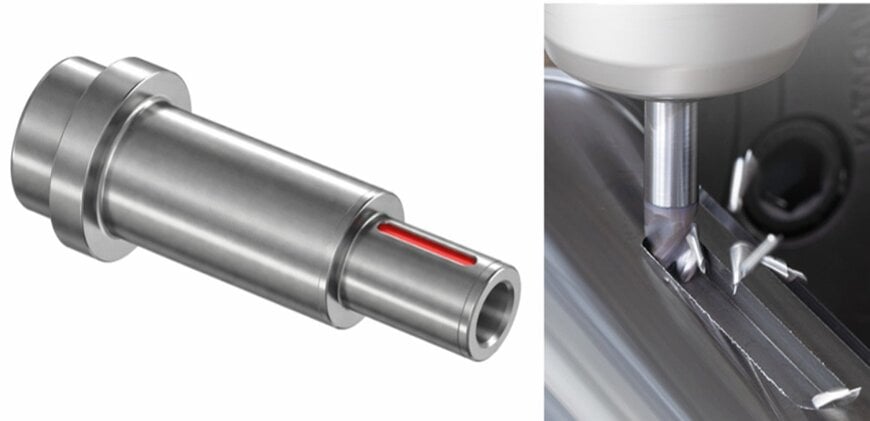
Engineered for power transmission manufacturing across automotive, aerospace, heavy machinery, and electric vehicle drive systems, this tool addresses the mechanical bottlenecks of closed pocket keyway production. The milling head combines center-cutting drilling geometry with lateral slotting and shoulder finishing capabilities within a modular tooling platform.
Kinematic Constraints in Closed Keyway Production
Machining closed pocket keyways on rotational shafts involves rigid toolpath trade-offs. Because closed pockets prevent lateral tool entry from the component boundary, machinists traditionally deploy three distinct process routes, each carrying operational penalties:
First, helical or linear ramping using a standard square end mill avoids tool changes but demands extensive entry distances. In deep keyway geometries, the extended ramping toolpath lengthens cycle times and subjects the cutting edges to variable axial-radial force vectors.
Second, repeated shallow peck milling cuts with small axial depths reduce mechanical loads but multiply tool passes. This approach increases cycle durations and causes uneven cutter wear.
Third, drilling a pilot hole followed by rough slotting and peripheral finishing isolates the mechanical tasks. However, this method requires two to three separate cutting tools, dedicated spindle pockets, driven-tool units on turning centers, and frequent tool changes. In high-mix or space-constrained lathe turrets, dedicated pilot drills increase tool management overhead and offset setup times.
Integrated Tool Geometry for Multidirectional Operations
The TungMeister VVFH system combines three mechanical features to bridge vertical plunge cutting and high-load lateral milling:
- Three Center-Cutting Edges: The tool geometry incorporates three cutting flutes that converge at the center point. During Z-axis plunging, all three edges engage simultaneously. This distributes axial cutting forces evenly across the tool profile, preventing center stalling and establishing balanced entry into solid stock without a pre-drilled pilot hole.
- Expanded Flute Volume: Plunge drilling into solid material restricts chip clearance because the surrounding workpiece walls constrain the cutting zone. The VVFH head incorporates deep chip pockets providing 150 percent of the flute volume found in conventional end mill designs. This volume prevents chip packing during direct axial penetration and eliminates chip recutting during subsequent full-slot lateral feed passes.
- Variable Lead Geometry: Transitioning from vertical penetration to 100 percent radial slotting generates strong radial forces and intermittent cutting excitation. The variable helix angle breaks harmonic vibration cycles, dampening chatter and stabilizing side wall generation during full-width engagement.
Shank Configurations and Structural Rigidity
Operating multidirectional milling heads requires managing deflection caused by radial force vectors during full-slot and finishing passes. Two shank architectures optimize tool dynamics:
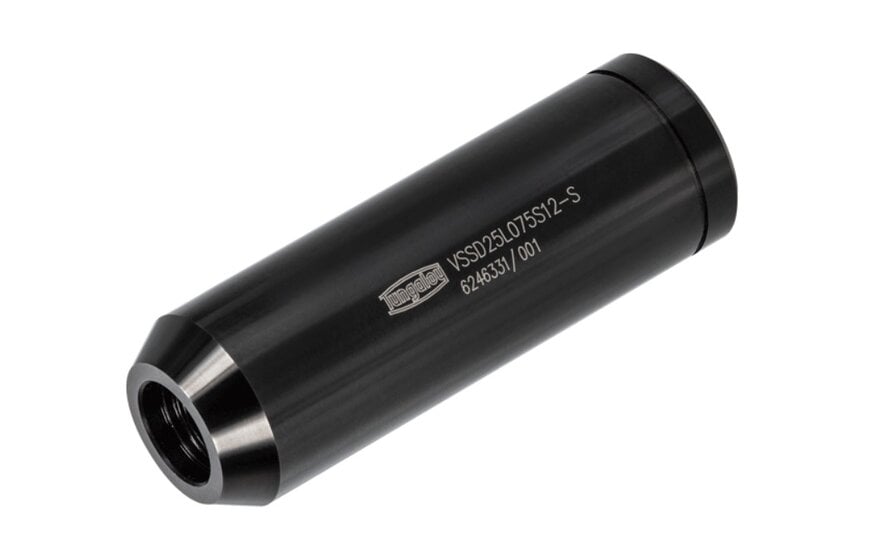
- VSSD High-Rigidity Shanks: Manufactured with a shank body diameter exceeding the threaded connection joint, this design resists bending moments under heavy radial cutting pressures. In internal slotting validations, the VSSD shank maintained chatter-free cutting performance at up to three times the axial depth of cut of solid end mill benchmarks.
- VER Integrated ER Collet Shanks: Designed for driven tooling stations on CNC lathes, Swiss-type automatics, and multitasking centers, this configuration integrates the holder taper directly into ER collet sizes ER11 through ER25. Eliminating intermediate toolholder projections shortens overall assembly overhang, preserving system rigidity within compact machine envelopes.
Industrial Production Applications
Production data across mechanical engineering sectors demonstrate cycle reductions and wear stabilization:
In an electric vehicle motor shaft application machining SCM440 alloy steel (27 to 35 HRC) with a 10 mm slot width, 400 mm length, and 4.5 mm depth of cut, replacing an 8 mm high-speed steel tool with an 8 mm VVFH head in grade AH715 on a VSSD shank altered the failure mechanism. The tool eliminated catastrophic edge fracture, shifting wear to predictable flank abrasion. Tool output increased from five to 30 workpieces per head at an identical cutting speed of 23 meters per minute and feed rate of 45 millimeters per minute.
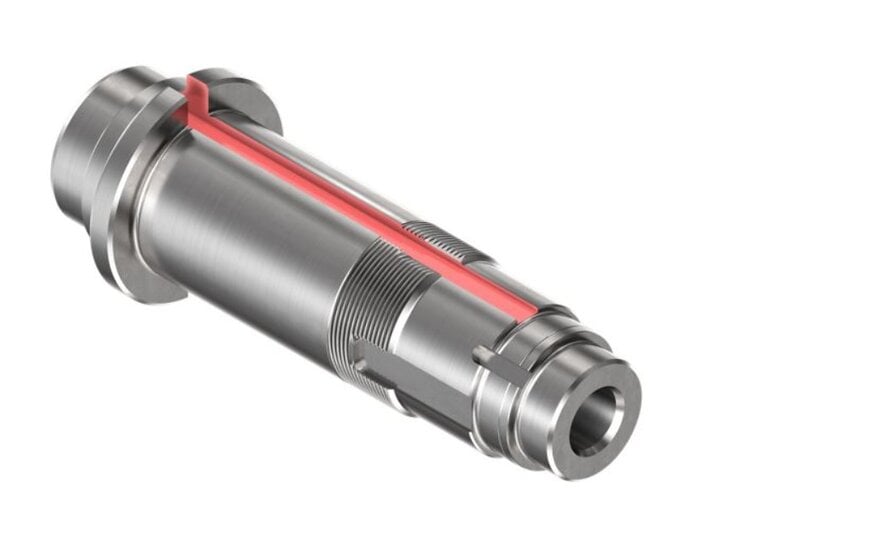
In a transmission shaft application machining SCM420 and SCM430 steel, three separate steps (flat drill pilot, roughing end mill, finishing end mill) were consolidated into two steps using a single 10 mm VVFH head. Operating at a drilling speed of 60 meters per minute (feed per tooth of 0.03 mm) and a slotting speed of 100 meters per minute (axial depth of 3.5 mm, feed per tooth of 0.07 mm), the tool assembly achieved a material removal rate of 23.4 cubic centimeters per minute while reducing tool change times.
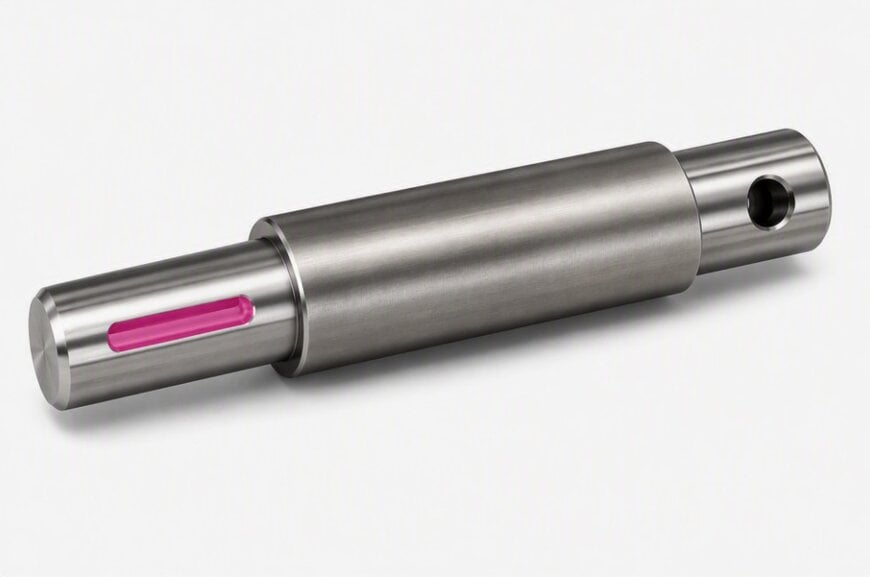
In an S45C medium-carbon steel diesel engine shaft keyway (8 mm width, 5 mm depth, 58 mm length), the consolidated drilling and slotting process replaced a competitor's two-tool sequence. Increasing the feed per tooth to 0.03 mm raised the feed rate from 95 to 215 millimeters per minute, increasing component throughput from 126 to 160 parts per head and reducing machining time from 240 seconds to 75 seconds.
Additional Context
This section details technical specifications and competitive benchmarking not included in the original product announcement.
Exchangeable-head carbide milling systems have evolved into a core strategy for lean machining, balancing the rigidity of solid carbide tools with the indexing speed of insert tooling. In the keyway milling domain, comparable platforms include the Iscar Multi-Master (such as the MM TS and center-cutting MM EC lines) and the Seco Minimaster modular systems. Benchmarking exchangeable-head systems involves three criteria: thread connection rigidity, axial plunge capability, and chip pocket clearance during full-slotting.
Production data across mechanical engineering sectors demonstrate cycle reductions and wear stabilization:
In an electric vehicle motor shaft application machining SCM440 alloy steel (27 to 35 HRC) with a 10 mm slot width, 400 mm length, and 4.5 mm depth of cut, replacing an 8 mm high-speed steel tool with an 8 mm VVFH head in grade AH715 on a VSSD shank altered the failure mechanism. The tool eliminated catastrophic edge fracture, shifting wear to predictable flank abrasion. Tool output increased from five to 30 workpieces per head at an identical cutting speed of 23 meters per minute and feed rate of 45 millimeters per minute.
In a transmission shaft application machining SCM420 and SCM430 steel, three separate steps (flat drill pilot, roughing end mill, finishing end mill) were consolidated into two steps using a single 10 mm VVFH head. Operating at a drilling speed of 60 meters per minute (feed per tooth of 0.03 mm) and a slotting speed of 100 meters per minute (axial depth of 3.5 mm, feed per tooth of 0.07 mm), the tool assembly achieved a material removal rate of 23.4 cubic centimeters per minute while reducing tool change times.
In an S45C medium-carbon steel diesel engine shaft keyway (8 mm width, 5 mm depth, 58 mm length), the consolidated drilling and slotting process replaced a competitor's two-tool sequence. Increasing the feed per tooth to 0.03 mm raised the feed rate from 95 to 215 millimeters per minute, increasing component throughput from 126 to 160 parts per head and reducing machining time from 240 seconds to 75 seconds.
Additional Context
This section details technical specifications and competitive benchmarking not included in the original product announcement.
Exchangeable-head carbide milling systems have evolved into a core strategy for lean machining, balancing the rigidity of solid carbide tools with the indexing speed of insert tooling. In the keyway milling domain, comparable platforms include the Iscar Multi-Master (such as the MM TS and center-cutting MM EC lines) and the Seco Minimaster modular systems. Benchmarking exchangeable-head systems involves three criteria: thread connection rigidity, axial plunge capability, and chip pocket clearance during full-slotting.
- Thread Interface Rigidity: The Tungaloy TungMeister system relies on an internal threaded carbide-to-shank connection designed to support radial bending loads. In comparison, systems like the Iscar Multi-Master utilize solid carbide threaded joints with radial contact faces, while Seco Minimaster utilizes an internal central thread with dual-surface contact. The enlarged core profile of the VSSD shank aims to bridge the static rigidity gap between exchangeable-head assemblies and solid carbide end mills.
- Plunge-to-Slot Transition: Most three- and four-flute modular end mills in this category feature unequal flute spacing for chatter suppression, but only specific variants incorporate center-cutting geometry suitable for direct Z-axis drilling. Standard high-feed or shoulder heads require ramping angles between 1 and 3 degrees to clear center dead zones. The VVFH head incorporates true center-cutting geometry across all three flutes, enabling vertical feed rates up to 0.03 mm per tooth in carbon and alloy steels without pre-drilling.
- Volumetric Chip Removal: During 1xD full-slotting operations, tool life in exchangeable systems is typically constrained by chip evacuation rather than flank wear. While two-flute modular plunging heads (such as Seco Minimaster Plunging variants) maximize pocket space, they limit allowable table feed rates. Conversely, conventional four-flute modular heads restrict pocket depth. The three-flute design with a 150 percent flute volume expansion establishes an operational balance, permitting feed rates between 0.03 and 0.07 mm per tooth while maintaining sufficient flute depth to evacuate chips without high-pressure internal through-coolant.
