
metalworkingmag.com
01
'26
Written on Modified on
Indexable Shoulder Milling Cutters for Unstable Setups
Tungaloy expands its TungForce-Rec cutter line with new imperial pitch configurations to suppress vibration during deep-shoulder milling in low-rigidity setups.
tungaloy.com
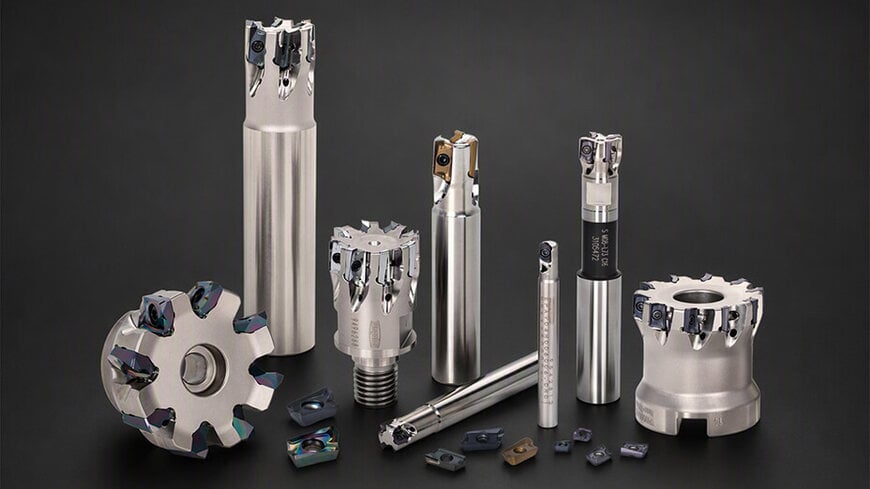
Machining complex, thin-walled workpieces in the aerospace, automotive, die and mold, power generation, and general industrial sectors presents ongoing stability challenges, particularly when long tool overhangs or lower-rigidity spindles induce regenerative chatter and premature tool wear. To address harmonic resonance and poor surface finishes in North American machine shops operating in standard imperial dimensions, Tungaloy expanded its TungForce-Rec series of high-precision shoulder milling cutters with new body options for Sizes 12 and 18.
Overcoming Harmonics and Deflection in Long-Overhang Milling
In shoulder milling, slotting, and pocketing, radial cutting forces can trigger high-frequency deflection when tools extend far beyond the gauge line. In unstable setups—such as clamping complex, asymmetrical parts or utilizing aging machine platforms—high insert-density cutters often engage too many teeth simultaneously. This continuous high cutting force exacerbates vibration, degrades Ra surface finish, and shortens insert edge life.
Mitigating these harmonic tendencies requires balancing tool pitch, cutting forces, and machine tool power. Machinists frequently require specialized tooth counts across medium-diameter bodies, particularly around the 2-inch (50.8 mm) threshold, to disrupt harmonic frequencies without sacrificing cycle efficiency.
V-Bottom Clamping Architecture and Pitch Variations
TungForce-Rec cutters utilize double-edged inserts secured via a specialized V-shaped bottom geometry. This indexing mechanism locks each insert mechanically into its pocket using a single clamping screw. The angled locating surfaces resist centrifugal and radial displacement under heavy chip loads, providing high edge rigidity and dimensional repeatability across square-shoulder applications. The expanded line addresses cutting force dynamics through tailored insert spacing for North American production workflows:
In the Size 12 platform (TPAV12 shell mill series), Tungaloy introduced an 8-insert configuration for 2-inch (50.8 mm) diameter cutters. This geometry sits directly between the existing 5-insert coarse-pitch and 12-insert fine-pitch bodies, establishing an intermediate chip-clearance and feed-rate threshold that balances feed velocity with vibration dampening.
In the larger Size 18 platform (TPAV18 shell mill series), a 5-insert variation was added for 2-inch (50.8 mm) bodies. This coarse-pitch layout reduces the number of cutting edges in the cut simultaneously compared to the standard 7-insert version, lowering machine horsepower draw and suppressing tool deflection. Complementing this, an 8-insert configuration on a 2.5-inch (63.5 mm) cutter body broadens parameters for deep-shoulder slotting under marginal workpiece rigidity.
Technical Parameters and System Integration
The TungForce-Rec family covers cutting depths up to 0.650 inches (16.5 mm) across multiple mounting options:
Imperial tooling configurations support Sizes 06, 12, and 18, accommodating cutting diameters from 0.313 inches to 6 inches, with axial cut limits ranging from 0.236 inches to 0.650 inches. Metric configurations support Sizes 04, 06, 12, and 18 across 6.0 mm to 160 mm cutter diameters with depth capacities from 4.0 mm to 16.5 mm.
Mounting interfaces include standard cylindrical shanks, arbor-mounted shell mills, and screw-on modular heads. The modular configurations integrate with Tungaloy's TungFlex tooling system, enabling machinists to select customized shank extensions and damping adaptors to minimize overhang ratios in deep-cavity dies and aerospace structural frames.
Additional Context
This section details technical specifications and competitive benchmarking not included in the original product announcement.
Square shoulder milling with indexable tooling conventionally relies on standard ISO/ANSI shapes, such as APMT/APKT parallelograms or CCGT/CNMG turning inserts adapted into milling headers. Conventional flat-bottom pocket pockets rely heavily on friction and side-wall tolerances to resist lateral cutting forces, which can permit micro-movement under interrupted cuts and cause screw fatigue or pocket deformation.
V-bottom seating geometries—similar to mechanical interlocks seen in high-feed milling platforms—distribute axial and radial forces across two distinct planes. This configuration delivers comparable mechanical retention to three-screw wedge designs while preserving internal body mass for coolant delivery passages and higher pocket densities.
In medium-diameter roughing and semi-finishing operations, unequal tooth spacing and coarse-pitch designs serve as mechanical dampeners. By varying the angle between teeth or reducing concurrent tooth engagement to fewer than two cutting edges at any single moment, cyclic excitation forces remain below the threshold required to trigger self-excited chatter across common spindle ratings (including CAT40/BT40 interfaces).
Edited by Evgeny Churilov, Induportals Media - Adapted by AI.
www.tungaloy.com
