
metalworkingmag.com
01
'26
Written on Modified on
Control Cabinet-Free Automation and Motion Architecture for Metal Processing
Beckhoff introduces a decentralized hardware and multi-core control software ecosystem to accelerate machine commissioning in sheet metal forming applications.
www.beckhoff.com
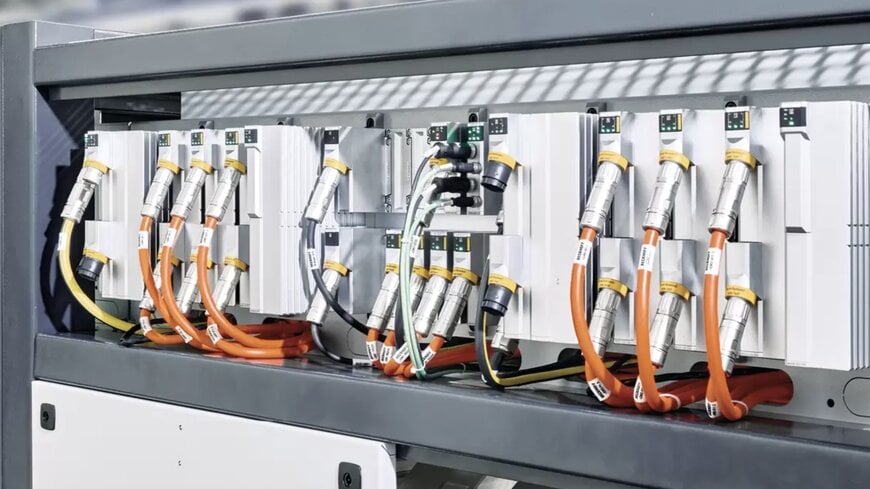
Beckhoff is releasing a suite of end-to-end automation solutions designed to optimize machine footprint and processing speed in sheet metal manufacturing. This PC-based control platform consolidates motion control, computer numerical control (CNC), and vision processing into a unified architecture for industrial metal forming and cutting applications.
At the EuroBLECH 2026 exhibition in Hanover from October 20 to 23, the automation provider will showcase its decentralized hardware and software ecosystem. By shifting functional expansions from hardware additions to software configurations, the system reduces interface complexity and overall engineering effort for machine builders.
Decentralized Hardware for Control Cabinet-Free Automation
To address shrinking batch sizes and the need for higher machine efficiency, the MX-System replaces traditional control cabinets with modular, pluggable components. Featuring an IP67 protection rating, these decentralized function modules perform all the tasks of a conventional electrical cabinet directly on the machine frame. By decentralizing the automation hardware, machine builders significantly reduce the overall footprint and cabling requirements. The plug-and-play modules maintain UL, CSA, and International Electrotechnical Commission (IEC) certifications, allowing for global deployment without architectural modifications. Configuration is handled through a web-based interface, and diagnostic data is accessible via mobile devices for service personnel.
Multi-Core Motion Control and CNC Integration
For hydraulic presses and forming machines, the TwinCAT MC3 motion control software utilizes multi-core processing to distribute axis control across multiple CPU cores. This allows axes with varying cycle times to operate on a single core without a fixed numerical limit on programmable axes. The software integrates hydraulic systems directly into the control architecture, featuring manufacturer-independent control of position, speed, and pressure for valve-regulated and pump-controlled drives. Electric and hydraulic axes are programmed using standard PLCopen-compliant function blocks, allowing engineers to mix real and simulated axes to reduce commissioning time. For cutting and electrical discharge machining (EDM) equipment, the CNC platform supports up to 32 simultaneously interpolating path axes per channel, scaling up to 128 axes across 32 channels using DIN 66025 programming.
Synchronized Machine Vision and Neural Network Processing
The automation architecture synchronizes quality assurance with machine cycles by utilizing EtherCAT P and distributed clocks to trigger image capture directly from the controller. This synchronization increases cycle rates while reducing external wiring and hardware footprint. Additionally, the TwinCAT 3 machine learning software executes neural networks directly within the controller for surface inspection and adaptive feed control. A no-code interface allows operators to train and update models during active operation without requiring machine downtime or software recompilation.
Additional Context
This section details technical specifications and competitive benchmarking not included in the original news release.
In the industrial automation market, cabinet-free solutions are primarily benchmarked on ingress protection ratings, modularity, and the ability to eliminate centralized electrical enclosures. The MX-System competes directly with decentralized architectures like the Siemens SIMATIC ET 200pro and the Bosch Rexroth ctrlX DRIVE cabinet-free system. While Siemens and Bosch Rexroth offer robust IP65 and IP67 distributed input/output (I/O) and motor controllers that minimize cabinet size by relocating components directly onto the machine frame, the Beckhoff architecture fully replaces the conventional control cabinet. It achieves this by consolidating the industrial PC (IPC), drive modules, and I/O into a single plug-and-play IP67-rated baseplate. Additionally, in motion control, the ability to distribute axes with varying cycle times across multiple central processing unit (CPU) cores addresses a core limitation of legacy CNC controllers, which typically enforce strict architectural limits on axis counts per processing channel.
Edited by Aishwarya Mambet, Induportals Editor, with AI assistance.
www.beckhoff.com
