
metalworkingmag.com
07
'26
Written on Modified on
Hard Turning Versus Cylindrical Grinding Process Cost Calculator
Tungaloy Corporation launched the Grinding Cost Reduction Calculator to model operational savings when replacing finishing grinding stages with superabrasive insert turning.
tungaloy.com
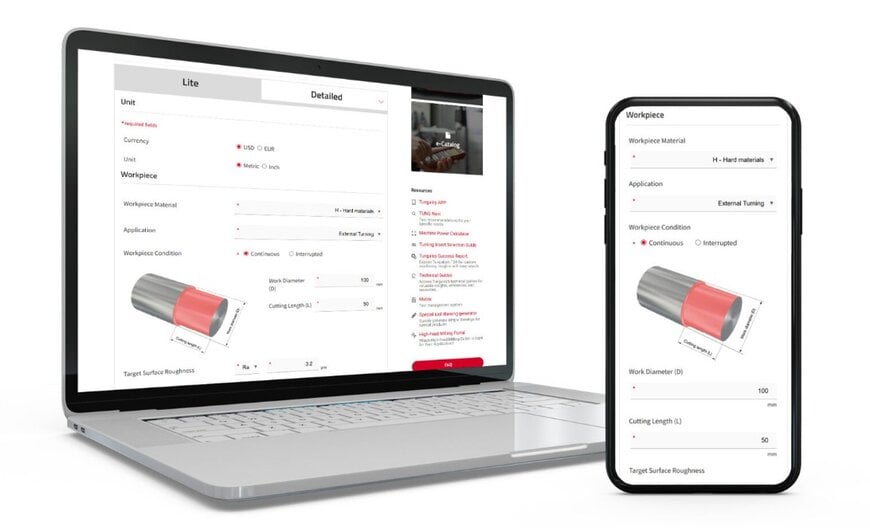
Finishing hardened steel and heat-resistant alloys traditionally requires cylindrical or surface grinding, a secondary operation characterized by long cycle times, dedicated machinery, and coolant management overhead. The Grinding Cost Reduction Calculator addresses this bottleneck by evaluating the economic and physical viability of transitioning from abrasive grinding to single-point turning using polycrystalline cubic boron nitride (PCBN) or technical ceramic tooling.
Engineering Mechanics of Eliminating Grinding Operations
In modern precision manufacturing, hard turning involves machining workpieces with hardness ratings typically exceeding 45 to 65 HRC directly on standard computer numerical control (CNC) lathes. Grinding processes remove material slowly via bonded abrasive wheels, necessitating multi-setup handling, periodic wheel dressing, and specialized filtration systems to extract grinding sludge.
Transitioning to single-point turning with superabrasive inserts exploits the high thermal stability and extreme hardness of PCBN and advanced ceramics. Unlike grinding wheels, single-point tools generate continuous chips, allowing higher feed rates and substantially greater material removal rates. This shift enables manufacturers to perform roughing and finish operations within a single machine setup, eliminating transfer delays between lathes and grinding cells while achieving comparable surface finish requirements (Ra values).
Calculation Workflow and Machining Parameter Optimization
The web-based software functions as an engineering decision-support model. Users input specific operational parameters, including workpiece material, hardness, existing grinding cycle duration, hourly machine cost rates, and annual production volumes. The algorithm evaluates these parameters against hard turning machining dynamics to calculate total unit cost differences and floor-to-floor cycle time reductions.
Beyond economic modeling, the tool generates technical recommendations tailored to the entered cutting conditions. It outputs recommended insert substrate grades—such as specific PCBN binder compositions or ceramic matrix types—along with nominal surface speeds (vc), feed rates (fn), and depths of cut (ap). This provides process engineers with immediate technical baselines required to prevent thermal shock, control tool wear mechanisms like cratering, and maintain dimensional tolerances.
Industrial Integration Across Component Manufacturing
The primary industrial use cases center on automotive powertrain and transmission manufacturing, bearing production, and precision fluid-power components. Typical components include gear shafts, transmission pinions, drive flanges, and hydraulic spools where case-hardened surfaces require fine tolerances.
Implementing hard turning in these workflows reduces capital investment by eliminating dedicated grinding stations. The dry or minimal-quantity lubrication (MQL) capabilities of PCBN turning also resolve environmental and disposal challenges associated with water-soluble grinding fluids and swarf cake processing. The calculator is accessible across desktop and mobile browsers, allowing production engineers, toolroom managers, and estimators to assess process feasibility directly on the shop floor or during project quoting.
Additional Context
This section details technical specifications and competitive benchmarking not included in the original product announcement.
Single-point turning of hardened materials is standardized across manufacturing engineering under ISO turning classifications, where PCBN corresponds to the ISO 513 group H designation for hardened steels. PCBN tools exhibit thermal conductivity exceeding that of cemented carbide, remaining chemically inert to ferrous workpieces at interface temperatures reaching 1,000 degrees Celsius. In contrast, mixed ceramic inserts (aluminum oxide with titanium carbonitride) provide cost-effective alternatives for uninterrupted finish cuts at slightly lower impact levels.
Benchmark analyses in automotive transmission manufacturing show that hard turning can lower unit processing times by 60 to 80 percent compared to cylindrical grinding, depending on workpiece geometry. While grinding remains necessary for complex contours, uninterrupted bores with high length-to-diameter ratios, and sub-micron surface finish tolerances (Ra under 0.1 micrometers), hard turning routinely holds dimensional tolerances within IT6 and surface finishes between Ra 0.2 and 0.4 micrometers. Online analytical tools from cutting tool manufacturers benchmark baseline manufacturing metrics to de-risk machine retooling before capital commitments are made.
Edited by Evgeny Churilov, Induportals Media - Adapted by AI.
www.tungaloy.com
