
metalworkingmag.com
23
'26
Written on Modified on
Compact Driven Nut Architecture for Electromechanical Linear Actuation
Kammerer Gewindetechnik introduces a space-saving ball screw mechanism that simplifies lubrication and replaces hydraulic cylinders in heavy-duty industrial machinery.
www.kammerer-gewinde.de
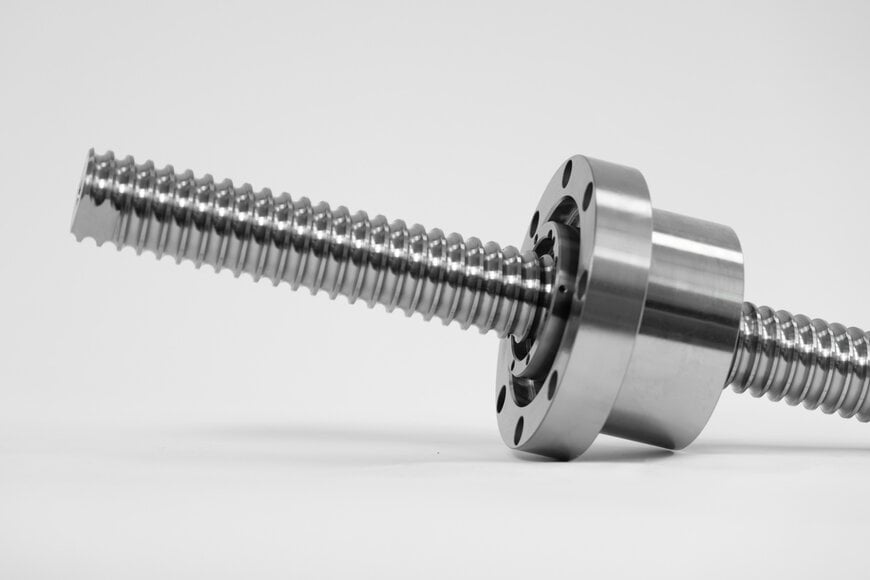
Kammerer ball screw drive with new nut concept. (Image source: Joshua Rzepka for Kammerer Gewindetechnik)
Kammerer Gewindetechnik GmbH & Co. KG is releasing a redesigned driven nut architecture for ball screws to address spatial constraints in high-dynamic linear motion applications. The electromechanical system is engineered to handle extended travel distances, high speeds, and heavy compressive forces within machine tools, presses, and automated tube bending equipment.
Mechanical Interface and Lubrication Consolidation
The driven nut minimizes the mechanical interfaces between force application and force transmission, isolating contact to the rolling elements to maximize mechanical efficiency and reduce the overall footprint. Traditionally, driven nuts require separate lubrication ports for the ball screw nut and the integrated ball bearing, necessitating dual supply channels, instructions, and metering units. The redesigned Kammerer mechanism consolidates this into a single lubrication point located on the bearing ring, which distributes the required minimum lubricant quantity to both the ball screw nut and the ball bearing simultaneously.
Kinematic Configurations for Linear Motion
The architecture supports two distinct kinematic installations based on the fixed component within the linear motion system. In standard machine tool configurations, the threaded spindle is clamped at both ends to remain stationary while the driven nut and its bearing housing travel axially. This configuration allows for the movement of heavy loads, such as traveling columns, over extremely long distances while preventing high-speed spindle vibration. Conversely, the driven nut can be mounted in a fixed position to actuate the spindle. In this setup, the rotating nut drives the torque-bearing spindle outward from the housing, mimicking the linear extension of a pneumatic or hydraulic piston rod.
Electromechanical Replacement of Hydraulic Actuators
When configured as a fixed-position actuator, the ball screw drive serves as a direct electromechanical alternative to hydraulic cylinders in industrial presses and bending machines. By eliminating the need for external hydraulic power units and fluid lines, the motor-driven actuator connects directly to the system's control architecture. This configuration ensures exact positioning and simplifies the recording of force-displacement curves during short-cycle, high-compression operations. Available in nominal diameters ranging from 16 mm to 60 mm, the system features a highly integrated manufacturing process where all performance-critical components—including the spindle, nut, and flange bearing ring—are engineered and machined in-house by Kammerer.
Additional Context
This section details technical specifications and competitive benchmarking not included in the original news release.
In the electromechanical actuation sector, driven nut ball screws compete directly with integrated electromechanical cylinders (EMCs) from global motion control manufacturers such as Bosch Rexroth, THK, and Schaeffler. While standard driven nut assemblies often feature separate housings and bearing blocks that expand the axial footprint and require complex lubrication routing, Kammerer’s integration of the flange bearing ring and a unified lubrication path measurably reduces the overall assembly length and maintenance overhead.
Furthermore, replacing traditional hydraulic cylinders with electromechanical ball screw drives typically increases overall system energy efficiency from approximately 40% (accounting for continuous hydraulic pump and valve losses) to over 80%, while eliminating hydraulic fluid handling. The 16 mm to 60 mm nominal diameter range covers the majority of medium- to heavy-duty automated manufacturing requirements, though competitors like Bosch Rexroth and Schaeffler offer extended ranges exceeding 80 mm for specialized, ultra-heavy pressing applications.
Edited by Aishwarya Mambet, Induportals Editor, with AI assistance.
www.kammerer-gewinde.com
