
metalworkingmag.com
17
'25
Written on Modified on
Laser and Plasma Processes for Advanced Packaging
TRUMPF presents laser etching and plasma power technologies designed to improve efficiency, process stability, and cost control in semiconductor manufacturing.
www.trumpf.com
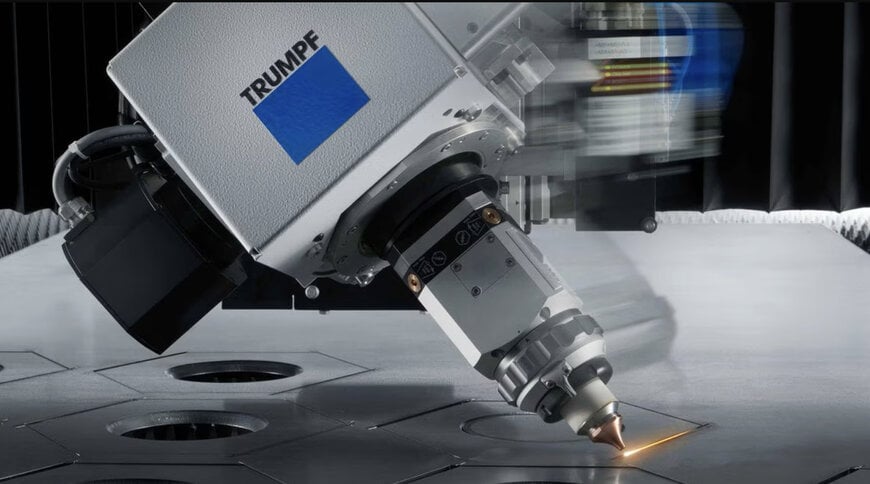
At Semicon Japan 2025 (Dec 17-19), TRUMPF will present laser- and plasma-based manufacturing technologies aimed at reducing production costs, improving process control, and supporting advanced packaging in semiconductor fabrication, including applications for AI-driven chips.
Manufacturing challenges in advanced packaging
The semiconductor industry is expanding rapidly while facing tighter requirements for precision, throughput, energy efficiency, and sustainability. Advanced packaging architectures, which integrate multiple chips on a single interposer, place particular demands on drilling accuracy, metallization quality, and plasma process stability. According to TRUMPF, its laser and plasma portfolio is designed to address these constraints in high-volume chip production. As Michael Samtleben, Managing Director of TRUMPF in Japan, explains, the technologies target “efficiency, precision, and sustainability” while enabling production of next-generation microchips for data-intensive applications.
Laser-assisted processing of glass interposers
A key focus is advanced packaging using glass interposers. Compared with silicon, glass offers lower material costs, making it attractive for cost-sensitive, high-performance devices. Creating electrical connections in these interposers requires drilling large numbers of through-glass vias (TGV), often amounting to millions of holes per panel.
TRUMPF’s approach combines ultrashort pulse laser processing with a downstream chemical etching step. The laser selectively modifies the glass structure, after which an etching solution forms precise vias. Process coordination between laser parameters and etching chemistry is critical to achieving consistent hole geometry. TRUMPF reports that this combined process has already been validated in collaboration with the SCHMID Group, which specializes in etching systems for semiconductor manufacturing.
HiPIMS coating for high-aspect-ratio vias
Beyond laser drilling, TRUMPF addresses metallization challenges in TGV structures using High Power Impulse Magnetron Sputtering (HiPIMS). The process is designed to deliver uniform copper deposition along via sidewalls, a prerequisite for reliable subsequent filling. TRUMPF’s HiPIMS implementation uses a rectangular waveform that increases ionization energy and achieves deposition rates reported to be nearly twice those of conventional HiPIMS systems. Compared with DC sputtering, the process produces denser and more conductive copper films.
When combined with synchronized bias technology in a fully integrated system, the HiPIMS process supports uniform copper filling even in very high aspect-ratio vias. TRUMPF positions this combination of laser drilling and HiPIMS coating as a scalable solution for high-volume advanced packaging, with a focus on reproducibility and process control.
Stabilizing plasma etching with RF power control
TRUMPF will also present a new generation of high-frequency power supplies designed to improve plasma process stability in chip manufacturing. The system continuously monitors plasma response during processes such as plasma etching and adjusts output energy in real time. This closed-loop control is intended to stabilize plasma conditions and maintain consistent layer quality across the wafer.
The modular platform covers power levels from 2.5 to 10 kW and is designed for integration into new or existing fabrication equipment. TRUMPF states that the system can also be used to retrofit older installations. From an efficiency perspective, the new generation reduces power consumption by approximately 20 percent and lowers waste heat, contributing to reduced operating costs and improved energy management.
Local support and energy efficiency focus
To support semiconductor manufacturers in Japan with global operations, TRUMPF has expanded its local infrastructure, including the opening of the Miyagi Technical Center in Miyagi Prefecture in 2023. Energy efficiency is a central concern for many customers, as advanced manufacturing processes increase power demand while grid expansion can be limited. TRUMPF indicates that its technology development and local support strategy are aligned with these constraints, focusing on efficient plasma and laser processes suited to industrial-scale semiconductor production.
www.trumpf.com
