
metalworkingmag.com
05
'26
Written on Modified on
Styler Powers Modular Welding for High-Speed Cylindrical Cell Production
Modular workstation design combined with Styler precision welding systems is helping battery manufacturers scale cylindrical cell production with greater speed, flexibility, and weld consistency.
www.stylerwelding.com
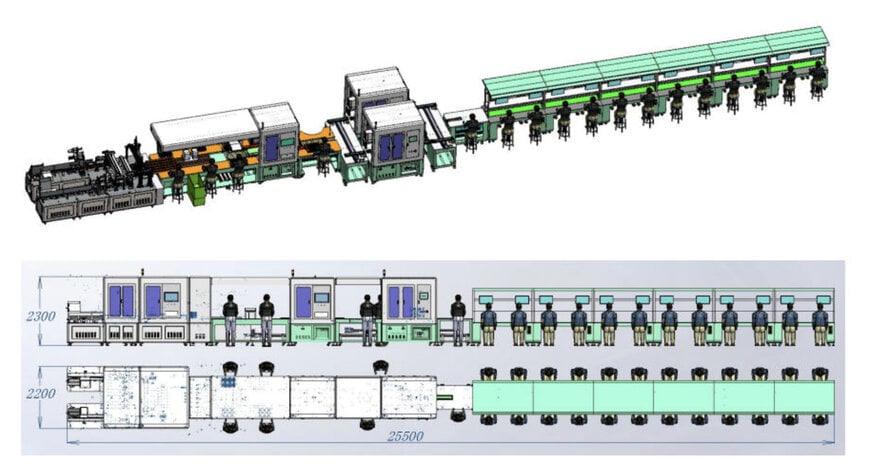
In the race to meet surging global demand for electric vehicles and energy storage systems, battery manufacturers face a familiar but intensifying challenge: scaling production while maintaining strict standards for quality, safety, and flexibility. At the center of this challenge lies cylindrical cell assembly, where precise and repeatable welding directly determines electrical performance, thermal behavior, and long-term reliability. Increasingly, manufacturers are finding that speed alone is not the answer. Instead, smarter production architectures—built around modular welding workstations—are becoming the foundation of future-proof battery manufacturing.
Why fixed welding lines are reaching their limits
Traditional linear welding lines are typically designed around a single product configuration. While effective for high-volume, low-mix production, they struggle in today’s battery market, where cell formats such as 18650, 21700, and emerging large-format cylindrical cells continue to evolve. Changes in module layouts, busbar designs, or weld patterns often require extensive mechanical rework, long changeover times, and costly production downtime.
This rigidity creates risk. In an industry defined by rapid innovation and shifting customer requirements, production systems must adapt without bringing entire lines to a halt.
Modular welding workstations: scalability by design
Modular welding workstations address this challenge by restructuring production into independent, function-specific modules. Instead of a single, monolithic line, manufacturers deploy discrete automation units for tasks such as cell positioning, busbar placement, welding, inspection, and material handling.
This architecture delivers several key advantages:
- Scalable throughput: Additional welding modules can be added in parallel to increase output without redesigning the entire line.
- Fast changeovers: New cell formats or module designs typically require updates only to fixtures or end-effectors, not core motion or control systems.
- Higher uptime: Individual modules can be serviced or upgraded while the rest of the system continues operating, reducing single points of failure and improving overall equipment effectiveness (OEE).
For high-speed cylindrical cell production, this modularity transforms welding from a bottleneck into a controllable, expandable process.
Precision welding at the core of each module
At the heart of every welding module is the technology responsible for creating low-resistance, mechanically robust joints between cell tabs and busbars. Here, precision is non-negotiable. Variations in weld energy, force, or alignment can lead to inconsistent electrical performance or latent safety risks.
Integrating Styler precision spot welders into modular welding workstations provides a stable foundation for these critical joints. Styler welders are designed to deliver consistent energy output and controlled welding force, which is especially important when working with thin nickel, copper, or nickel-plated steel components commonly used in cylindrical cell assemblies. Stable weld formation minimizes spatter, limits thermal stress on the cell, and supports long-term pack reliability.
When combined with servo-driven motion systems and programmable weld sequences, these welding modules can execute complex weld patterns across dense cell matrices with high repeatability, even as production speeds increase.
From modular workstations to hybrid production lines
Modular design also enables efficient semi-automated production concepts that balance automation with human expertise. In a typical hybrid cylindrical cell line, operators may handle tasks such as fixture loading, visual inspection, or auxiliary assembly, while automated welding modules perform all critical electrical joints.
For example, a palletized cell fixture can move through a sequence of stations where automated modules equipped with Styler welders complete busbar-to-tab welding with consistent quality. The same pallet can then proceed to manual or inspection stations before continuing downstream. This approach preserves flexibility, optimizes labor usage, and ensures that the most quality-critical steps remain fully automated.
Building resilient battery production systems
As battery manufacturers look beyond today’s demand and toward future cell formats, modular welding workstation design offers a clear strategic advantage. It enables production systems that grow incrementally, adapt quickly, and maintain high weld quality even as product requirements change.
By pairing this modular architecture with proven precision welding solutions such as Styler spot welders, manufacturers can achieve high-speed cylindrical cell production without compromising reliability or safety. The result is a production floor that is not only faster, but also more resilient—capable of supporting continuous innovation in battery design for years to come.
www.stylerwelding.com
Precision welding at the core of each module
At the heart of every welding module is the technology responsible for creating low-resistance, mechanically robust joints between cell tabs and busbars. Here, precision is non-negotiable. Variations in weld energy, force, or alignment can lead to inconsistent electrical performance or latent safety risks.
Integrating Styler precision spot welders into modular welding workstations provides a stable foundation for these critical joints. Styler welders are designed to deliver consistent energy output and controlled welding force, which is especially important when working with thin nickel, copper, or nickel-plated steel components commonly used in cylindrical cell assemblies. Stable weld formation minimizes spatter, limits thermal stress on the cell, and supports long-term pack reliability.
When combined with servo-driven motion systems and programmable weld sequences, these welding modules can execute complex weld patterns across dense cell matrices with high repeatability, even as production speeds increase.
From modular workstations to hybrid production lines
Modular design also enables efficient semi-automated production concepts that balance automation with human expertise. In a typical hybrid cylindrical cell line, operators may handle tasks such as fixture loading, visual inspection, or auxiliary assembly, while automated welding modules perform all critical electrical joints.
For example, a palletized cell fixture can move through a sequence of stations where automated modules equipped with Styler welders complete busbar-to-tab welding with consistent quality. The same pallet can then proceed to manual or inspection stations before continuing downstream. This approach preserves flexibility, optimizes labor usage, and ensures that the most quality-critical steps remain fully automated.
Building resilient battery production systems
As battery manufacturers look beyond today’s demand and toward future cell formats, modular welding workstation design offers a clear strategic advantage. It enables production systems that grow incrementally, adapt quickly, and maintain high weld quality even as product requirements change.
By pairing this modular architecture with proven precision welding solutions such as Styler spot welders, manufacturers can achieve high-speed cylindrical cell production without compromising reliability or safety. The result is a production floor that is not only faster, but also more resilient—capable of supporting continuous innovation in battery design for years to come.
www.stylerwelding.com
