
metalworkingmag.com
16
'26
Written on Modified on
Modular automation strategies for flexible CNC production
Tezmaksan Robot Technologies examines how modular automation architectures help manufacturers balance standardisation and flexibility in high-mix manufacturing environments.
www.tezmaksan.com
Manufacturers introducing automation increasingly face the challenge of balancing system flexibility with deployment cost and engineering complexity, particularly in CNC machining and aerospace supply chains. In this context, Hakan Aydoğdu, CEO at CNC automation specialist Tezmaksan Robot Technologies, outlines a modular automation approach aimed at balancing standardisation and customisation in production environments.
Production variability reshaping automation decisions
Across sectors such as aerospace and general manufacturing, suppliers are facing increasing production variability as OEMs shift complexity down the supply chain. This includes managing higher part variety, tighter tolerances and shorter changeover windows, often without increases in labour or available production space.
Industry data highlights structural barriers to automation deployment. Research from Make UK identifies skills shortages and labour availability as major constraints affecting automation adoption. Similarly, the Aerospace, Security and Defence Industries Association of Europe (ASD) reported in its 2024 Facts and Figures report that workforce and supply chain constraints continue to limit aerospace production output despite demand growth.
These conditions are increasing interest in automation strategies that can support flexible manufacturing rather than fixed production scenarios.
Limits of fully customised or fully standardised automation
Historically, many automation projects have been designed around specific parts or production scenarios. While such customised automation cells may initially optimise throughput, they often require reprogramming, engineering changes or downtime when product specifications or order volumes change.
Conversely, fully standardised automation systems may simplify deployment and reduce engineering costs but can lack the adaptability required in high-mix manufacturing. CNC machining environments typically process varied materials, part geometries and batch sizes, which can limit the utilisation of rigid automation cells.
As a result, manufacturers increasingly evaluate where standardisation provides efficiency and where customisation remains necessary for operational flexibility.
Modular automation as a practical compromise
Modular automation approaches separate standardised infrastructure from application-specific customisation. Core system components such as robot arms, safety architectures, control systems and interfaces are typically standardised to reduce engineering risks and commissioning time.
Customisation is then applied at the application level, for example through end-of-arm tooling, workpiece handling strategies, pallet configurations and cell layouts.
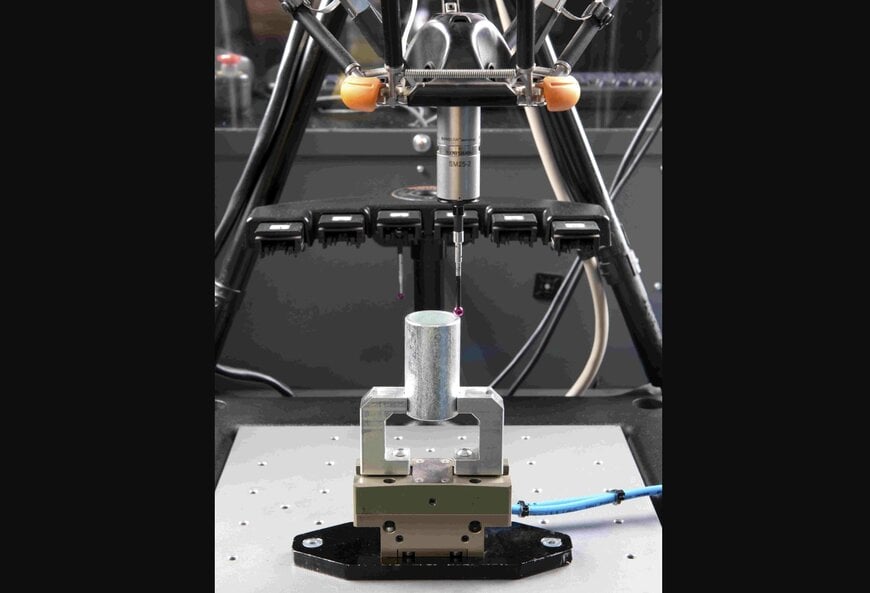
This architecture allows manufacturers to modify production setups without requiring full system redesigns. Grippers can be exchanged, fixtures adapted and workflows reconfigured without replacing core automation components.
In CNC environments, this supports gradual automation adoption. A typical implementation may begin with automated loading and unloading of a single machine and later expand toward multi-machine automation or extended unattended operation. Such staged deployment is enabled by the reuse of standardised automation platforms.
Application in aerospace supply chains
The approach is particularly relevant in aerospace manufacturing, where suppliers often operate high-mix, low-volume production environments with strict quality and traceability requirements. Modular automation allows these manufacturers to scale automation utilisation without committing to highly customised systems designed for uncertain future production volumes.
This staged approach also allows manufacturers to distribute investment over time while maintaining compliance requirements and process traceability within the broader digital supply chain.
Platform examples supporting modular automation concepts
Examples of this approach include Tezmaksan Robot Technologies’ CubeBOX CNC automation cell and RoboCAM software, which combine standardised robotic cell architectures with configurable handling systems and software layers.
Such systems are designed so that automation can evolve alongside production requirements rather than being designed solely around initial production assumptions. The objective is to apply customisation where production flexibility is required while maintaining standardisation where system stability is critical.
Automation as an evolving production capability
Automation strategies are increasingly treated as continuous development processes rather than one-time capital investments. Standardised automation platforms can provide stability, while configurable tooling and interfaces allow adaptation to changing product mixes and production requirements.
Manufacturers adopting this approach may be better positioned to respond to fluctuating demand and production variability by balancing the benefits of standardisation with the flexibility provided by selective customisation.
Edited by industrial journalist, Aishwarya Mambet — AI-powered.
www.tezmaksanrobotics.com
