
metalworkingmag.com
08
'26
Written on Modified on
Composite Milling Tool with Diamond-Coated Performance
Sandvik Coromant introduces a solid carbide milling solution to improve process reliability and productivity in abrasive composite machining.
www.sandvik.coromant.com
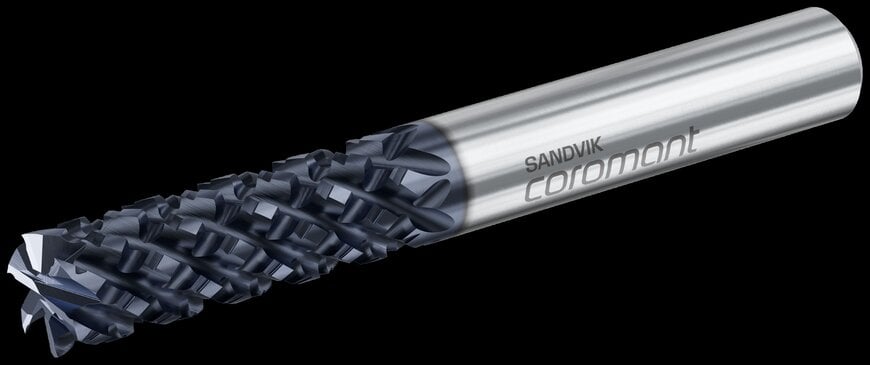
Sandvik Coromant has launched a new solid carbide milling tool designed for machining abrasive composite materials. The tool combines a diamond-coated grade with a dual-cutting mechanism to address common challenges such as delamination, fibre pull-out, and rapid tool wear in high-performance applications.
Addressing machining challenges in composite materials
Composite materials used in aerospace, automotive, defence, and marine applications present distinct machining difficulties due to their abrasive nature and heterogeneous structure. Issues such as fibre delamination, incomplete cutting, vibration, and accelerated tool degradation can compromise both component quality and process stability.
The newly introduced tool is developed for ISO O materials and incorporates a patented dual-cutting mechanism. This mechanism produces a scissor-like cutting action, enabling controlled fibre shearing and reducing the likelihood of structural damage during milling operations.
Diamond coating and tool life performance
The tool features a chemical vapor deposition (CVD) diamond coating engineered to withstand the high abrasiveness of composite materials. The coating is bonded to a dedicated substrate, ensuring adhesion stability and consistent cutting performance under thermal and mechanical stress.
Field test data indicate a tool life increase of up to 100% compared to the previous coating grade. This improvement directly impacts machining efficiency by reducing tool change frequency and associated downtime.
Process stability and machining efficiency
In addition to durability, the tool design supports high material removal rates through an optimized flute geometry with increased chip evacuation capacity. Efficient chip removal is critical in composite machining to prevent re-cutting and thermal accumulation.
The tool also operates with reduced vibration levels, contributing to improved surface quality and lower acoustic emissions in workshop environments. This is particularly relevant in precision manufacturing contexts where dimensional accuracy and operator conditions are critical.
Application scope across industries
The tool supports a range of milling operations, including slotting, ramping, and edge trimming. These capabilities are applicable to the production of structural composite components such as fuselages, wings, spars, ribs, and frames in the aerospace sector.
Beyond aerospace, the solution is suitable for composite machining in automotive lightweight structures, defence systems, and marine components, where consistent machining performance and structural integrity are required.
Positioning within composite machining technologies
Diamond-coated carbide tools are a recognized benchmark for machining fibre-reinforced composites due to their wear resistance and cutting precision. Compared to conventional carbide grades, diamond-coated solutions offer extended tool life and improved edge retention.
The integration of a dual-cutting geometry with a high-adhesion diamond coating positions this tool within the upper performance range of composite milling technologies, particularly for applications requiring both high productivity and process reliability.
Edited by an industrial journalist Sucithra Mani with AI assistance.
www.sandvik.coromant.com
