
metalworkingmag.com
14
'26
Written on Modified on
Grooving systems enhance stability in turning operations
Walter AG introduces new tooling systems to improve process reliability and flexibility in precision machining applications.
www.walter-tools.com
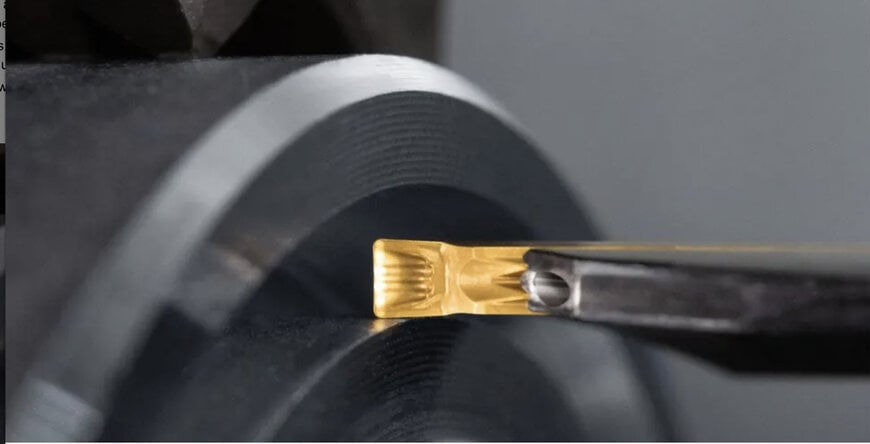
Walter AG has expanded its grooving tool portfolio with three new systems designed to improve machining stability, chip control, and tool life in turning operations. The developments target internal, axial, and radial grooving applications across a wide range of industrial machining environments.
New systems addressing diverse grooving requirements
The updated portfolio includes three systems tailored to different machining scenarios. The G5111-P axial grooving system supports cutting depths of 21, 25, and 33 mm, with insert widths ranging from 3.0 to 6.0 mm. Its internal coolant delivery system is directed at both free and flank surfaces, improving chip evacuation in axial contours and reducing the risk of chip accumulation during deep grooving operations.
For internal machining, the G5221 boring bar system is designed for diameters starting at 44 mm, with insert widths between 3 and 5 mm and a maximum cantilever length of three times the tool diameter. This configuration enables stable internal grooving up to a depth of 12 mm. The tool body features continuous reinforcement and an optimized geometry to reduce vibration, while an enlarged internal coolant channel enhances flushing of the cutting zone.
Universal solution for multi-directional grooving
The G55xx system extends the range with a more universal approach. It supports insert widths from 2.5 to 6.0 mm and enables radial grooving, groove turning up to 8 mm depth, as well as axial and 45° machining operations. Compatibility of inserts across toolholders allows a reduction in tool changes and setup times, improving efficiency in both single-part and series production environments.
This flexibility contributes to a more integrated digital supply chain, where tooling standardisation reduces complexity in production planning and inventory management.
Design features for increased process stability
All three systems share a dual-tooth insert interface designed to prevent lateral displacement of the cutting insert under load. This mechanical constraint increases positional stability during machining, particularly under high cutting forces or interrupted cuts.
In combination with wear-resistant coating grades such as Tiger·tec Gold, the tooling systems are engineered to support higher cutting parameters while maintaining tool life and dimensional accuracy. The combination of optimized cooling, reinforced tool bodies, and secure insert positioning contributes to consistent machining performance across different materials and batch sizes.
Relevance for precision manufacturing
The expanded grooving portfolio addresses key challenges in modern turning operations, including vibration control, chip evacuation, and tooling flexibility. These factors are critical in industries such as automotive, aerospace, and general engineering, where tighter tolerances and higher productivity requirements demand reliable and repeatable machining processes.
By integrating multiple grooving strategies within a unified tooling concept, the systems support more efficient machining workflows and reduced downtime, aligning with broader trends in process optimization and automated manufacturing environments.
Edited by an industrial journalist Sucithra Mani with AI assistance.
www.walter-tools.com
