
metalworkingmag.com
15
'26
Written on Modified on
High Stability Modular Parting And Grooving Tool System
Walter presents the WedgeFit modular system to optimize stability and process security during demanding parting and grooving turning operations in modern industrial manufacturing.
www.walter-tools.com
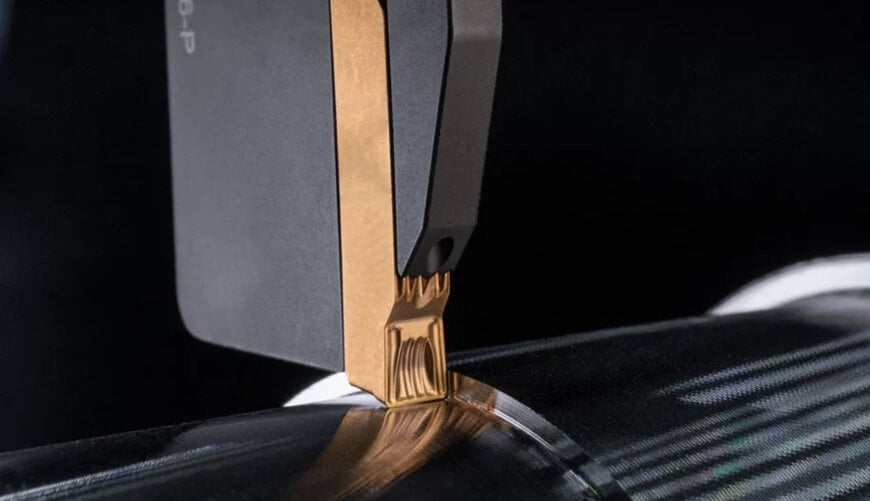
Parting and copying of difficult materials generate significant mechanical stresses that can lead to vibrations or the unexpected pull-out of the tool. To resolve this machining problem, Walter has developed the WedgeFit modular system, offering unprecedented structural rigidity for turning and grooving operations.
Mechanical Architecture And Insert Clamping
Machining nickel-based alloys of the ISO-S group exposes tools to high tensile forces, as the material tends to contract around the cutting edge. The WedgeFit system counteracts this phenomenon through a double dovetail holding mechanism combined with a lateral clamping secured by two TorxPlus screws. The insert clamping is performed from above, which considerably increases the holding forces compared to traditional lateral clamping systems and secures the insert against pull-out risks. The preload defined by the two lateral screws presses the module firmly into its seat, achieving a level of stability previously reserved for solid tools.
Cutting Parameters And Precision Cooling
Increased stability of the assembly translates directly into a reduction in the vibration level and an improvement in the reliability of the overall process. By combining this mechanical architecture with the double teeth of the Groov-tec inserts, operators can apply significantly higher cutting parameters. The optional integration of precision cooling, directed simultaneously at the rake and flank faces, promotes thermal control and chip evacuation. These combined technical optimizations allow for an increase in tool life of approximately 50 percent compared to conventional clamping systems.
Technical Specifications And Operational Flexibility
In a high-yield production environment, modularity limits machine downtime. In the event of hardware damage, only the affected module needs to be replaced, making changeovers and adjustments much faster. In its initial configuration, the equipment is marketed with GD26 type inserts, allowing for cutting depths of up to 26 millimeters, as well as with DX18 inserts for depths of up to 17 millimeters. Walter Capto attachments and standard square shanks are offered to facilitate integration across different machine tool architectures. The range will undergo progressive expansion incorporating new sizes of inserts and attachments.
Additional Context
This section details technical specifications and competitive benchmarking not included in the original product announcement
The optimization of grooving and parting operations represents a critical challenge in precision machining, particularly for the aerospace and energy sectors, which heavily machine refractory superalloys. Modular tooling systems are evaluated based on their ability to dampen harmonic vibrations and maintain strict tolerance under extreme thermomechanical loads. Competing technologies in the cutting tool market also emphasize internal precision cooling and rigid clamping interfaces to prevent insert micro-movement. The transition from lateral clamping to top clamping with a dovetail interface constitutes a technical reference standard for securing the insert against radial forces generated during tool retraction in deep grooves.
Edited by Maria Brueva, Induportals editor - adapted by AI.
www.walter-tools.com
