
metalworkingmag.com
21
'26
Written on Modified on
Automated Laser Cutting and Bending in Digital Supply Chains
Bystronic introduces an integrated manufacturing ecosystem featuring autonomous laser cutting cells and automated bending operations to optimize industrial sheet metal productivity.
www.bystronic.com
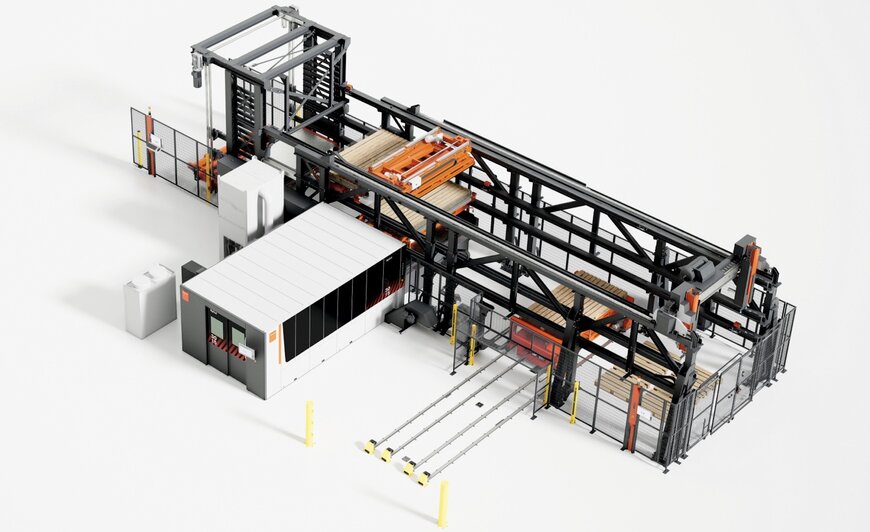
Bystronic is releasing a comprehensive portfolio of integrated hardware and software solutions that form a networked manufacturing ecosystem for automated sheet metal processing. Aimed at modern industrial fabrication and the digital supply chain, the interconnected production environment incorporates autonomous laser cutting operations, robotic bending cells, and data-driven material flow management software.
Intelligent Material Flows for Manufacturing Autonomy
The hardware and software configurations will be exhibited at EuroBLECH 2026 in Hanover, taking place October 20 to 23. Against rising cost pressures, shorter lead times, and a critical shortage of skilled workers in the manufacturing sector, these interconnected solutions mitigate labor dependency by linking individual fabrication steps. By leveraging intelligent material flows rather than standalone machines, manufacturing plants can achieve sustained, cost-effective autonomy across high-volume production cycles.
Integrated Laser Cutting Cell Integration
For raw material processing, a fully integrated cutting cell automates the production sequence from material retrieval to sorted part output. The configuration integrates a 20-kilowatt laser cutting system capable of processing material up to 50 millimeters thick, with table change times clocked at 28 seconds. Sheet formats up to 3,000 by 1,500 millimeters are manipulated via an automated loading and unloading module that manages maximum sheet weights of 950 kilograms. To optimize logistics, a dual-head sorting system automatically organizes finished parts weighing up to 50 kilograms each. Simultaneously, a compact storage tower accommodates raw materials and finished cassettes within a vertical footprint ranging from 3.8 to 5.6 meters.
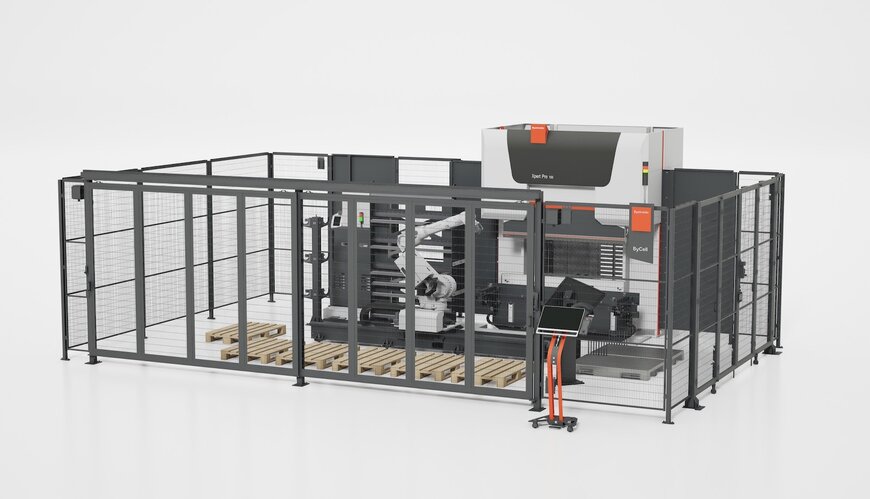
Bystronic Midsize Bending Cell
Robotic Bending Cell Architecture
For bending applications, mid-sized manufacturing facilities can implement an automated bending cell designed around a 150-ton press brake equipped with an extended 2,050-millimeter working length. The system supports prolonged autonomous cycles by utilizing an integrated four-meter conveyor line and up to eight standard pallets. A 70-kilogram payload robot handles workpieces weighing up to 30 kilograms. To ensure process reliability without manual intervention, bending precision is maintained via a dynamic crowning mechanism and a laser angle measurement framework that constantly verifies part geometry. A standalone version of the 150-ton press brake is also available, featuring a 3,100-millimeter bending length, high-speed Z-axis movements up to 1,500 millimeters per second, and a sliding table to reduce manual setup times.
Continuous Tube Processing and Software Orchestration
Modern tube processing demands are addressed by a high-performance, 10-kilowatt tube laser system that continuously processes open profiles and structural tubes ranging from 19 to 305 millimeters in diameter. It accommodates maximum tube lengths of 12.2 meters and integrates sequential drilling, thread cutting, and three-dimensional cutting into a single automated run. Controlling this hardware network is a comprehensive software suite that centralizes costing, planning, and manufacturing parameters, generating real-time data to drive actionable decisions across the networked ecosystem.
Additional Context
This section details technical specifications and competitive benchmarking not included in the original news release.
In the automated sheet metal processing sector, competitive benchmarking relies heavily on operational autonomy, maximum press tonnage, robot payload capacities, and real-time angle correction capabilities. Top-tier competitors such as TRUMPF and AMADA offer comparable robotic bending cells, utilizing similar frameworks designed for continuous unattended manufacturing. Performance metrics are frequently measured by angular precision tolerances—often hovering around ±0.1 degrees—and robotic axis flexibility. While TRUMPF focuses on tactile sensor angle measurement and Y-axis precision down to ±0.002 millimeters, Bystronic and AMADA utilize laser-based and automated angle measurement architectures. Furthermore, the integration of extensive offline programming software and high-payload robotics distinguishes premium automated cells, enabling continuous lights-out production flows across highly variable batch sizes.
Edited by Aishwarya Mambet, Induportals Editor, with AI assistance.
www.bystronic.com
