
metalworkingmag.com
18
'26
Written on Modified on
High-Power Laser Tube Cutting for Flexible Production
TRUMPF introduces an upgraded laser tube cutting system to increase throughput and flexibility in industrial fabrication environments.
www.trumpf.com
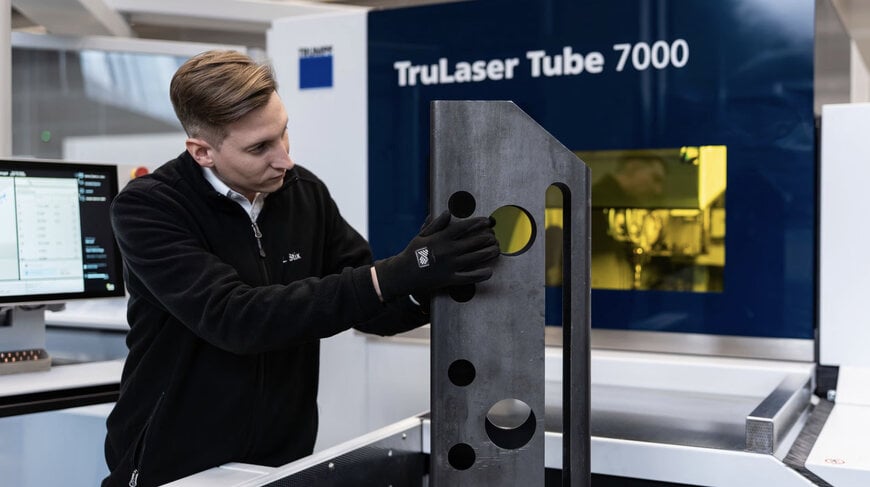
The latest generation of a high-power laser tube cutting machine is designed to improve productivity and processing flexibility in tube-based manufacturing. With nine kilowatts of laser output, the system targets applications in machine building, automotive production, construction, and agricultural equipment manufacturing, where varying geometries and material thicknesses are common.
Increased Throughput for Thick-Walled Tubes
The system enables higher processing speeds for thicker materials, particularly when using nitrogen as the cutting gas. For mild steel with a wall thickness of 8 mm, productivity increases of up to 30% and feed rate improvements of up to 150% are reported. These gains allow manufacturers to reduce cost per part while maintaining consistent output in high-volume environments.
The capability to process greater wall thicknesses expands the operational range of laser tube cutting, enabling a single machine to address a broader spectrum of applications. This is particularly relevant for manufacturers managing diverse product portfolios within a digital supply chain.
Extended Processing Range for Tube Geometries
An expanded outer circle of 290 mm increases the maximum dimensions of processable tubes. The system accommodates square profiles up to 203.2 × 203.2 mm, round tubes up to 273 mm in diameter, and rectangular profiles with side lengths up to 254 mm. At the same time, it maintains precision and speed for smaller diameters starting from 12 mm.
This extended range supports both high-mix and high-volume production scenarios, allowing manufacturers to switch between small and large components without reconfiguring equipment.
Adaptive Quality Control and Process Monitoring
Integrated assistance systems enhance part quality and process reliability. A sensor-based measurement function evaluates tube geometry and compensates for deviations caused by material inconsistencies. An additional control layer determines when such measurements are required, reducing unnecessary inspection cycles and improving processing efficiency.
Post-processing verification is performed through a laser-based inspection of cut contours, ensuring that scrap material has been fully removed. This reduces manual intervention and secondary finishing operations. Another feature enables automatic detection of pre-existing contours in pre-punched tubes, allowing the system to adapt cutting programs accordingly. This functionality supports the integration of semi-finished components into automated workflows.
Integration into the Automotive Data Ecosystem
The system is designed for integration into connected production environments. Real-time condition monitoring analyzes machine data to detect wear or deviations from target parameters, enabling predictive maintenance and reducing unplanned downtime.
Automated loading is supported through a standard loading unit with tilt-and-lift functionality, enabling seamless connection to storage systems and automated unloading solutions. Combined with compatible software interfaces, the system can be incorporated into a broader automotive data ecosystem or smart factory infrastructure.
Configuration for Variable Production Requirements
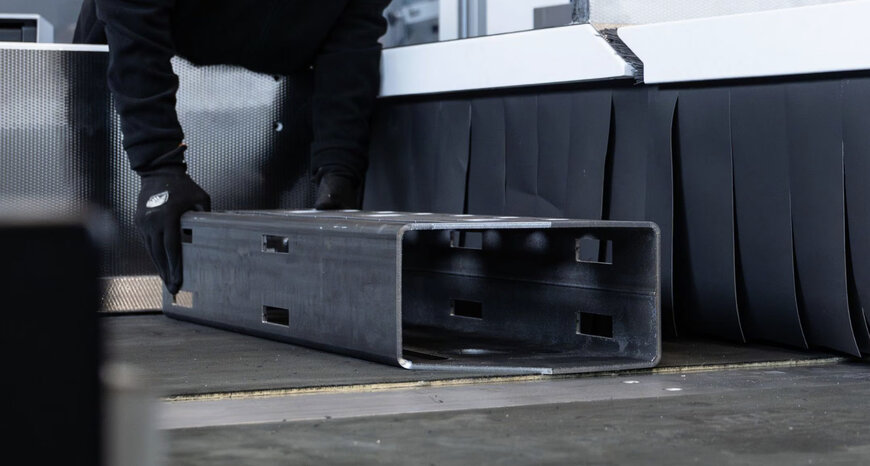
The machine is available with multiple loading and unloading configurations, supporting tube lengths of up to 12.5 meters. This modularity allows manufacturers to adapt the system to different production scales, from small batch sizes to continuous high-volume operations.
By combining high laser power, expanded geometric capacity, and integrated digital services, the system addresses the need for flexible, data-driven manufacturing processes across multiple industrial sectors.
Edited by Maria Brueva, Induportals editor - Adapted by AI.
www.trumpf.com
