
metalworkingmag.com
05
'26
Written on Modified on
TRUMPF TruLaser Weld 3000: Compact Robotic Welding Cell
TRUMPF presents the TruLaser Weld 3000, a compact laser welding cell for flexible processing of variable sheet metal assemblies within confined production environments.
www.trumpf.com
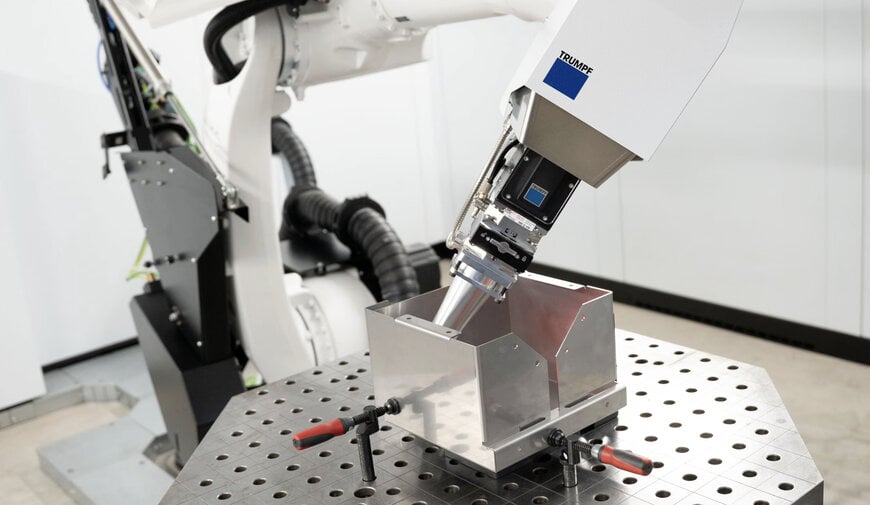
At EuroBLECH 2026 (October 20–23, 2026), TRUMPF is introducing a space-saving automation system for laser welding. The technology is specifically designed for apparatus and plant engineering, medical technology, and the production of sheet metal components for data centers.
Challenges in Sheet Metal Fabrication and Plant Automation
A shortage of skilled workers, limited production space, and frequently changing component geometries require space-saving and flexible plant architectures from manufacturing companies. The TruLaser Weld 3000 addresses these spatial requirements with a footprint of 3.65 x 3.65 meters. This represents a footprint reduction of around 24 percent compared to the smallest version of its predecessor system, the TruLaser Weld 5000. Despite the compact protective cabin, the cell processes pallet-sized workpieces, which is achieved by integrating a KUKA Iontec robot with a 2100-millimeter reach and the latest generation of control systems. To align the components, the user can choose between a classic welding table, a turn-tilt positioner, or a compact rotary changer for loading and unloading parallel to the main processing time.
AI-Supported Path Correction and Offline Programming
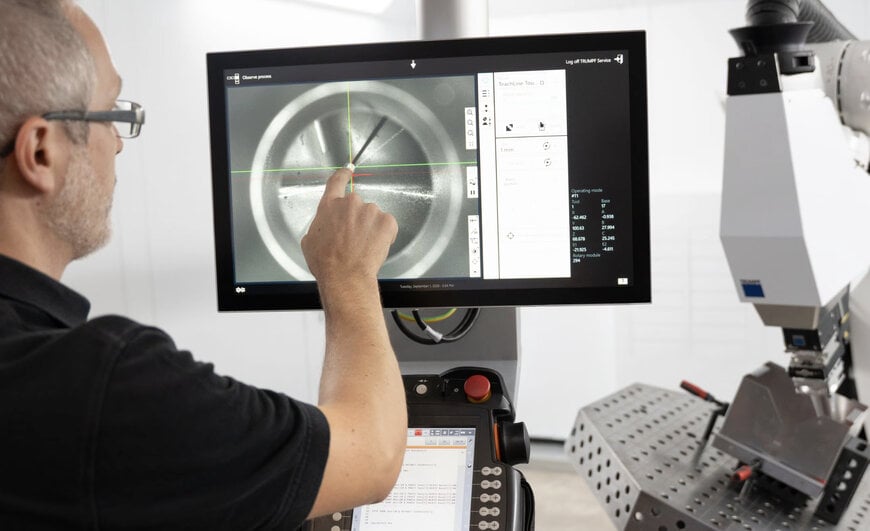
Switching between different components in small-batch production requires short setup times. The laser welding cell enables the parallel creation of welding programs based on CAD data via the TruTops Weld software while the machine remains in productive use. Deviations between the virtual CAD model and the real workpiece position are corrected by the machine control through the TeachLine AI function expansion. This AI-based method automatically detects welding spot deviations and adapts the robot path to the real component situation. Manual readjustments can also be made using the TeachLine Touch function by simply tapping on the machine screen, which reduces the total time for programming and setup by up to 50 percent. According to Moritz Berger, Product Manager at TRUMPF, the system enables stable processes, short lead times, and high manufacturing flexibility for assemblies with a high variety of variants.
Compact Welding Optics and Advanced Gap Bridging
To reach hard-to-access welding seams, for example in the interiors of deep housings or boxes, the system has been equipped with a 40 percent smaller welding optic. Various laser technologies are used for process stability and seam quality: BrightLine Scan combines a high-frequency scanner with a motorized focus adjustment, achieving wider welds to bridge gaps of up to 0.4 millimeters. In deep-welding processes, the BrightLine Weld function reduces spatter formation by dividing the laser power into an inner and outer core within the laser light cable. For larger gaps up to approximately 1.5 millimeters, FusionLine deliberately adds filler wire to the process to introduce material. Equipped with laser powers of three or four kilowatts, the system welds stainless steel and mild steel up to eight millimeters thick, as well as aluminum up to six millimeters thick.
Additional Context
This section contains technical specifications and competitive benchmarking that were not included in the original product announcement.
In the market for industrially enclosed laser welding cells, the TruLaser Weld 3000 positions itself in the medium to high performance segment (3 to 4 kW). While competitive compact welding solutions increasingly rely on lighter cobot architectures without full laser protective cabins to save space, TRUMPF offers an industrial system protected according to laser class 1 with a dedicated heavy-duty industrial robot (KUKA Iontec). Similar automated cell concepts can be found from providers such as Fronius or Yaskawa; however, the TRUMPF system differentiates itself through its proprietary beam shaping (BrightLine) and AI-supported image processing for automatic path correction (TeachLine AI), which makes complex clamping fixtures obsolete and shifts component-specific tolerance compensation directly into the machine control.
Edited by Maria Brueva, Induportals Editor – adapted by AI.
www.trumpf.com
